Seasonal Upkeep You Actually Keep Up With, and the Paperwork That Pays You Back
How to tell a thorough seasonal maintenance visit from a barely adequate one while standing in your own driveway, and what to keep so the spend still counts years later.
Douglas Mackenzie1,146 words
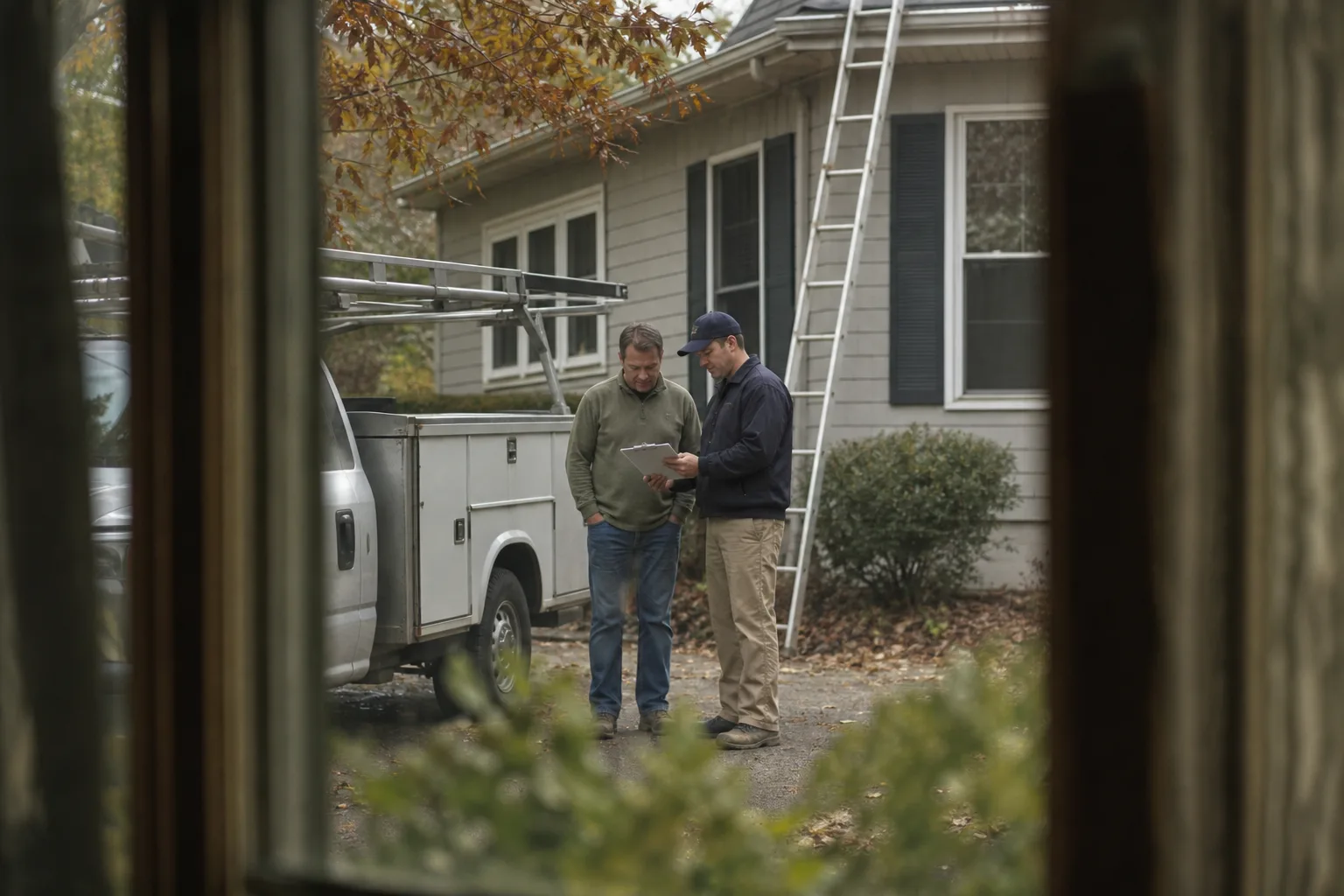
Most seasonal maintenance plans fail in the same place, which is not the first cold week but the third mild one, when nothing has gone wrong and the reminder gets pushed. The schedules that survive are built on triggers a household already notices: the first frost warning, the week the clocks change, the first mowing, the day the window units come out of the basement. Attaching a task to something you cannot help observing is more reliable than any app. And the second half of the job, the part almost nobody sets up in advance, is deciding what proof the visit leaves behind.
Tie the task to something you cannot miss
A schedule that lives on a calendar competes with everything else on that calendar and usually loses. A schedule anchored to a physical event does not. Gutters get cleared after the last leaves drop, not on a date in October chosen months earlier. The furnace gets serviced the week you first close the windows for good. Sprinklers get blown out when the overnight forecast first shows a number in the thirties. Homeowners who keep to this pattern report the same thing: they stopped tracking dates and started tracking conditions, and the work quietly got done.
The same logic applies to hiring. The good contractors in any seasonal trade are booked by the people who called before the trigger, not after it, which means the calendar still matters for scheduling even when it does not matter for remembering. A short list of who you called last year, with the number and what they charged, converts a scramble into a phone call. Keep it in the same place you keep the invoices. That single habit does more for continuity than any maintenance app on the market.
What a thorough visit leaves behind, and what a thin one does not
From the driveway, two gutter cleanings look identical: a truck, a ladder, an hour, a handshake. The difference shows in what you can verify afterward. A thorough crew runs water down every downspout and tells you which one is slow. They bag the debris and take it, rather than raking it into the beds. They mention the section of fascia that is soft, without turning it into a sales pitch, and they say whether it can wait a season. A barely adequate crew leaves the roof valley full and the downspouts untested, and you will not learn that until the first heavy rain.
Ask for photographs. This is the single most useful request a customer can make in any seasonal trade, and reputable crews already take them, because photographs protect the contractor as much as the client. Before and after images of a gutter run, a dryer vent termination, a heat exchanger, or a crawl space vapor barrier turn an invisible service into something you can inspect at the kitchen table. They also become evidence later, if an insurance adjuster asks whether the system was maintained, or if a buyer's inspector raises a question at closing three years on.
The other marker of a good job is a written note of what was found and not done. A crew that clears the gutters and reports two loose hangers has given you a maintenance item with a date attached. A crew that says everything looked fine has given you nothing you can act on or prove. Over a few seasons, those notes accumulate into a service history, and a service history is what turns a house full of aging equipment into a house with a known condition. That is worth more at sale than most cosmetic upgrades.
The invoice is a tax document, whether or not it reads like one
For a property that produces rental income, or for the qualifying portion of a home used regularly and exclusively for business, seasonal maintenance is generally deductible in the year it is paid, while work that betters, restores, or adapts the property has to be capitalized and recovered over years. The Internal Revenue Service oversees that distinction, and the language on your invoice is the first thing anyone reviewing the return will read. Cleaned and serviced existing gutters is a repair. Replaced gutter system with oversized seamless run is not. Same crew, same ladder, very different treatment.
So ask the contractor to describe the work performed rather than the outcome sold. Most will, if you ask before the invoice is written rather than after. Where a visit genuinely includes both, a cleaning and a partial replacement, ask for the amounts separated on the face of the invoice, because an unsplit total is a problem you inherit. For an owner-occupied home with no rental or business use, the seasonal spend is not deductible at all, but capital improvements still add to your basis and reduce gain when you sell, which is its own reason to keep the paper.
Keeping the record long enough to be worth having
Deducted maintenance needs records for as long as the return can be examined, which for most filers is measured in a few years from filing. Capitalized work is different, and this is where households lose money. A roof, a furnace, a driveway, an addition: those records need to survive until you sell the property and then long enough after that for the sale year's return to close. That can be twenty years or more, which means a shoebox in a basement is not a filing system. Scan the invoice the week it arrives and store it where a flood cannot reach it.
Name the files so they sort themselves. Year, property, trade, and whether the item is a repair or an improvement is enough, and doing that classification at the moment of payment is far easier than reconstructing it later from a faded thermal receipt. Pair each invoice with the photographs the crew sent, along with proof of payment, because a canceled check or card statement supports the amount while the invoice supports the character of the work. Two documents, one folder, one minute. That is the whole discipline.
What the customer actually controls
You cannot supervise a technician on a roof or inside a duct, and you should not try. What you can control is the request made before the work starts, the questions asked while the truck is still in the driveway, and the shape of the document that arrives afterward. Ask what will be tested, not just cleaned. Ask what was found and left alone. Ask for the invoice to describe the work rather than the benefit. Crews that do good work answer all three without hesitation, which is itself a useful signal.
The seasonal trigger gets the work done. The photographs and the wording on the invoice decide whether that work still counts for anything the year a buyer, an adjuster, or an examiner asks what you did and when.