Five Checks That Separate a Maintenance Schedule You Keep From One You Abandon in March
A schedule that survives past March looks different from the one people write in January, and the difference shows up years later in the condition a buyer walks through.
Anneliese Brandt1,036 words
Most household maintenance schedules die quietly in the third or fourth week, not because the owner stopped caring but because the list was written by someone imagining a calmer version of their own life. The consequences do not announce themselves either. A gutter that goes two seasons without attention does not produce a dramatic failure, it produces a stained soffit, a soft patch of siding, and a line on an inspection report four years later that costs money at closing. What follows are the five things worth checking before you commit to a schedule, in the order that actually determines whether it survives.
1. Whether every task has a fixed slot rather than a season
A schedule that says spring, summer, fall and winter is a wish, not a plan. Seasons have no edges, and a task assigned to fall gets pushed to the next warm Saturday until the warm Saturdays run out. The version people keep assigns tasks to a recurring slot they already own: the first Sunday morning of the month, the Saturday after the clocks change, the day the trash goes out. Week to week, that means the filter gets changed because the bin gets rolled to the curb, not because a page in a binder said October. The pairing is what carries it.
The everyday consequence of a floating season is uneven wear that nobody traces back to scheduling. Two identical houses on the same street diverge over six years, one with clean condenser coils and free-draining gutters, one with neither, and the difference at sale is not a single repair but a general impression of a house that has been watched. Buyers cannot itemize that impression. They price it anyway, in the offer and in how hard they push on the inspection.
2. Whether the schedule counts minutes honestly
Ask how long each task really takes, including finding the ladder, moving the recycling bin off the shelf where the filters live, and washing your hands afterward. A schedule built on optimistic durations collapses on the first week that runs long, and one collapsed week is usually enough to end the habit, because the list now carries a backlog and the backlog carries guilt. Ten minutes of genuinely ten-minute tasks beats an hour of tasks you have quietly labeled as an hour and privately budgeted as three. Honest minutes are the single strongest predictor of a schedule surviving the year.
This is also where the two-tier structure earns its place. Keep the short recurring tasks under your own hand and route the long ones, gutter clearing on a two-story elevation, chimney inspection, HVAC service, to a scheduled vendor visit with a date on it. The week-to-week reality of a good schedule is small and dull. The heavy work is a phone call made in advance, not a Saturday you lose.
3. Whether it covers the things a buyer will never see
Resale rewards the visible unevenly. Fresh paint reads immediately, a serviced water heater reads not at all, and yet the hidden items are the ones that generate the repair credits and the retrades. The Environmental Protection Agency is responsible for indoor air quality and moisture guidance, and the tasks that sit in that territory, condensate drains, bath fan operation, dryer venting, crawl space humidity, are exactly the ones a schedule tends to skip because nothing looks wrong. Nothing looks wrong right up until a home inspector opens a panel and writes a sentence that becomes a negotiating point.
Check the draft schedule for the invisible half deliberately. Anything that moves water, air or exhaust belongs on it, even where the task feels abstract, because those systems fail slowly and expensively while presenting a normal face to the room. The payoff is not a feature you can point to during a showing. It is an inspection report thin enough that the buyer stops looking for reasons to reprice.
4. Whether it produces a record you could hand to someone
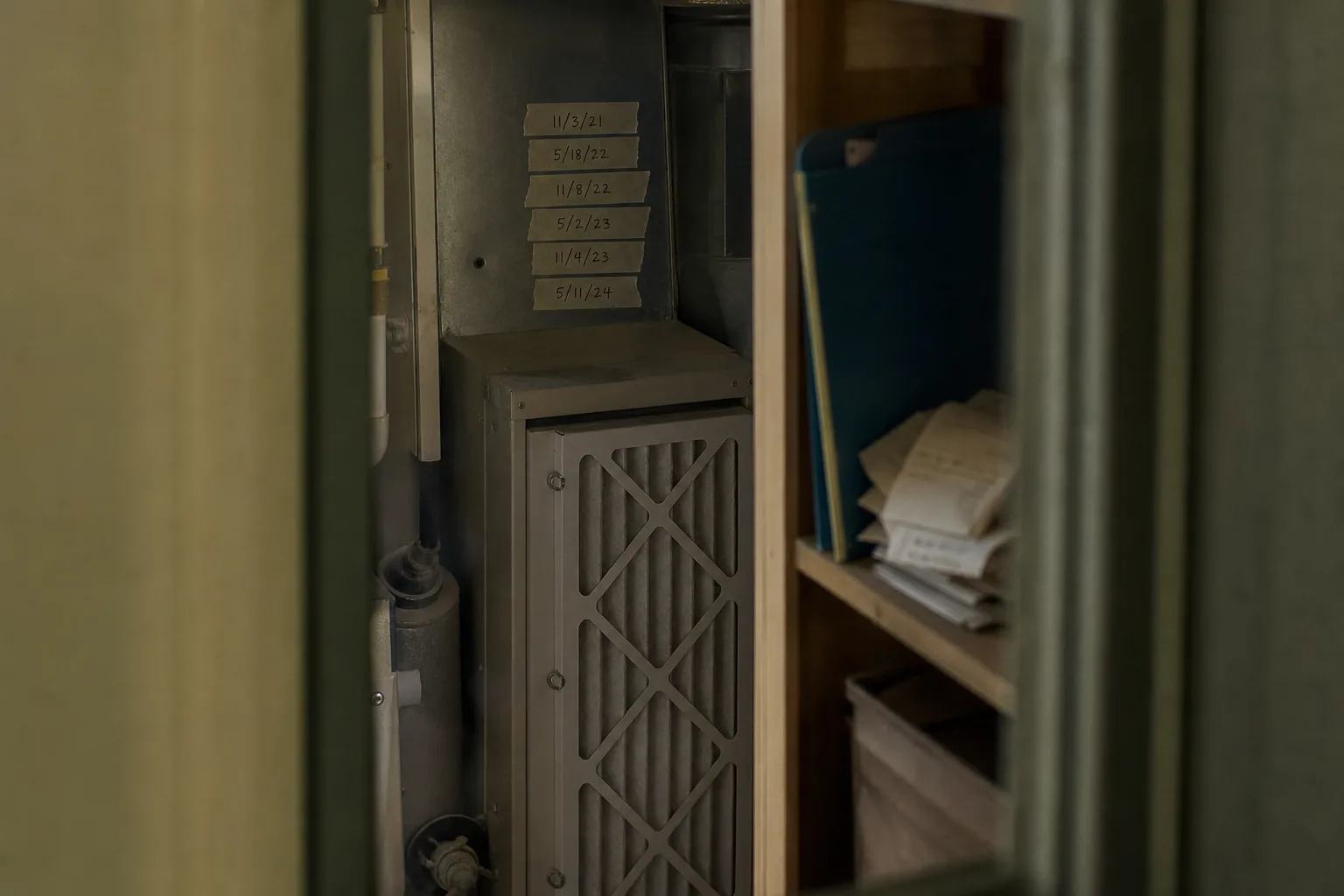
A schedule that leaves no trace has to be re-remembered every cycle, which is its own tax, and it also loses value the moment you sell. Dates written on the furnace filter housing, a single note file with a line per service, receipts kept in one folder rather than three drawers: any of these turn maintenance into evidence. Ordinary weeks benefit first, because you stop arguing with yourself about whether the filter was changed in August or September. That argument is one of the most reliable ways a schedule quietly stops running.
At sale, the record does specific work. It answers the age question on the roof, the water heater and the compressor without speculation, it supports the asking price on a house of a certain age, and it shortens the inspection conversation because the seller is not guessing. Documentation is also the cheapest item on the entire list, which makes it the one worth building in from the start rather than reconstructing later.
5. Whether you can cut it in half and still be covered
Test the draft by deleting the bottom half and asking what actually goes wrong. Usually the answer is very little, because most of the deleted items were cosmetic or optional, and the survivors are the water, drainage, exhaust and safety items that cause real damage when neglected. Keeping the shorter list is not a compromise. It is the version that runs for years, and a short schedule kept for six years outperforms a thorough one kept for five weeks by a margin no buyer will ever compute but every inspector can see.
Once the core list is stable and genuinely automatic, adding back the optional items is easy, because you are extending a working habit rather than starting one. That is the sequence that holds: prove the small version, record it, then grow it.
Write the schedule for the week you usually have, not the week you intend to have, and check it against these five questions before it goes on the wall. The houses that show well after a decade are rarely the ones that got the most attention. They are the ones that got a little, reliably, on a day that was already spoken for.