Rushing the Weekly Grocery Run? The Counter Staff Who Change What It Costs
The meat cutter, the produce manager and the person who sets markdowns are all part of a weekly food budget, and almost nobody asks them anything.
Anneliese Brandt735 words
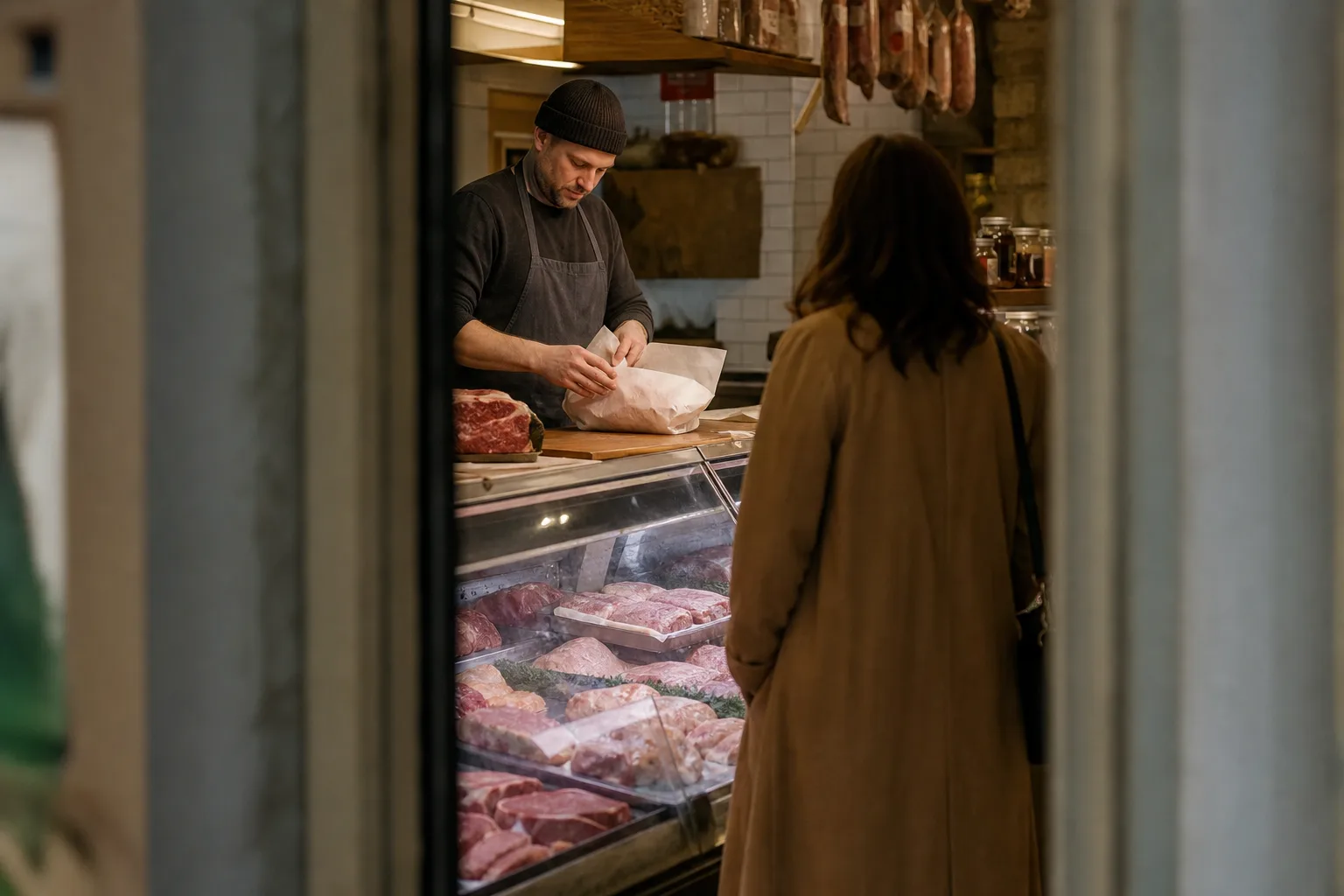
A weekly food budget is usually treated as a solo exercise: a number, a list, a fast lap through the store, and a total at the register that either worked or did not. What that framing leaves out is that a grocery store is staffed, and several of those people hold information that changes the arithmetic before you ever get to the shelf. The meat cutter, the produce manager, the person who runs the markdown cart. They are the party in the transaction most shoppers never speak to, and the rushed trip is precisely the trip that guarantees you will not.
The labor at the counter is already in the price
Pre-cut, pre-trimmed and pre-portioned product carries the cost of someone's time, and you are paying that cost whether or not you had the work done. A whole pork shoulder, a chuck roll, a bone-in chicken, all of them sit next to smaller packages of the same animal at a materially higher per-pound price, and the gap is labor. The counter will do that labor on request, at no charge, on the cheaper cut. Grinding, trimming, cutting into steaks, portioning into meal-sized packs, removing a bone and handing it back for stock.
The catch is sequence. This is not a thing you ask for at 5:40 on a Wednesday with a cart behind you and one cutter working the saw. It is a thing you ask for early in the day, or by phone the day before, which means the budget trip has to be planned far enough ahead that a phone call fits inside it. Labeling and grading on meat and poultry falls under the Department of Agriculture's Food Safety and Inspection Service, so what is on the package is regulated. What the person behind the glass will do with it is simply a conversation.
Markdowns run on a schedule somebody sets
The reduced rack is not luck. Someone decides when product gets marked down, by how much, and in what order departments do it, and that decision is made on a routine that rarely changes month to month. Bakery often runs at the end of the day, meat frequently runs in the morning against sell-by dates, produce moves when a case breaks down. Ask the department manager directly and you will usually get a straight answer, because it costs them nothing and it moves product they need to move.
Knowing the window converts a hopeful detour into a scheduled stop. It also changes what you plan to cook, because a markdown is only a saving if the item lands in a meal you were already going to make, and the decision to buy is effectively irreversible at that price point. You cannot return it, and the clock on it is short. Households that use markdowns well plan the week loosely and let one or two slots stay open for whatever the schedule delivers.
Case orders and the produce manager
Buying by the case is the least used lever in a grocery store and the easiest one to pull. Most produce and grocery managers will special order a full case at a price below the shelf unit rate, and they will tell you when the truck arrives so you are not storing it longer than you have to. Tomatoes for sauce, apples for freezing, whole chickens, dry goods in the shipper the store already receives. The step you cannot undo is the ordering itself, since a case ordered for you is a case you own, so the processing plan has to exist before the call, not after the delivery.
What a buyer never sees, and what it needs
None of this shows up in a kitchen when a house sells. A buyer walking through sees cabinets, counters, an appliance package, and none of them signal whether the household could break down twenty pounds of chicken on a Sunday. What actually carries this kind of cooking is unglamorous and mostly invisible on a listing: a chest freezer in the garage, enough sheet-pan-sized flat space to portion on, a sink deep enough to wash produce by the case. Those add little to a sale price and cost little to add, which makes them the rare improvement that is worth doing purely for you.
The fast trip is not cheaper. It just moves the labor into the package, where it is quiet, permanent and already paid for.