Resizing, Retipping or Leaving It Alone? What a Buyer Sees Later and What the Paperwork Proves
Which jewelry repairs add value at resale, which quietly subtract it, and the take-in ticket, appraisal and local rules that decide how the work is documented.
Anneliese Brandt1,012 words
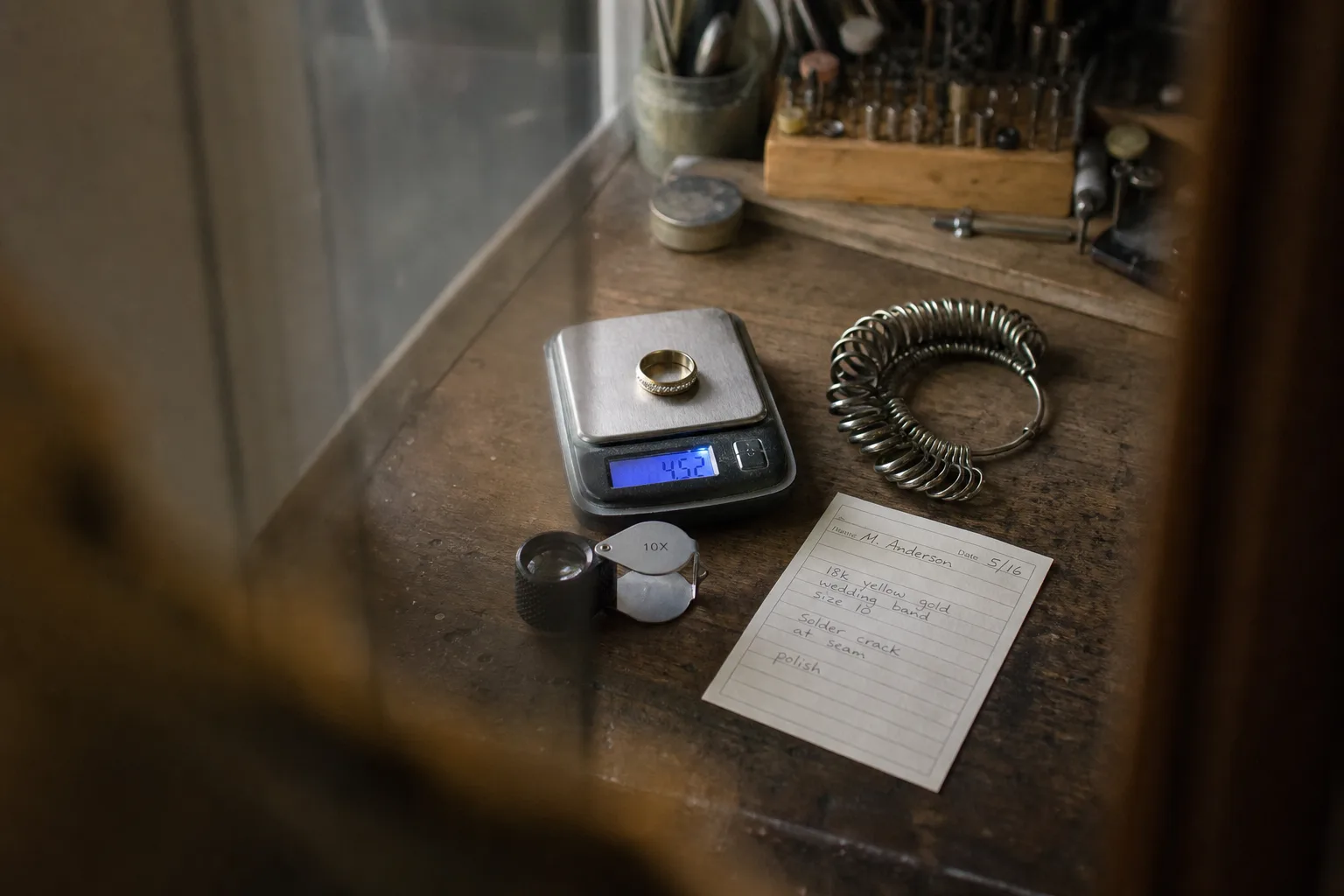
A repair ticket is a contract, a condition report and, several years on, the only evidence that a piece left the bench the same weight it arrived. Most people hand over a ring, take a claim stub with a four-word description, and never think about it again until an insurer, an heir or a buyer asks what was done. The order matters here: what you photograph and weigh before the work is not recoverable afterward, and the questions that decide resale value are cheapest to ask while the piece is still on your side of the counter.
The take-in ticket, and the five minutes before you hand it over
Bring the piece to a bench jeweler and you will be offered a claim check. Ask instead for a description that a stranger could match to the object: metal color and stamp, total gram weight on the shop scale, the number of stones, the approximate dimensions of the center stone, and any existing damage, a chipped girdle, a worn prong, a previous sizing seam. Photograph it yourself under decent light with a coin or ruler in frame, including the inside of the shank where marks live. Two photographs and a recorded weight cost nothing and settle almost every dispute that ever arises.
The tools that make this manageable are unglamorous and cheap. A ten-power loupe, a gram scale accurate to a tenth, a set of plastic ring gauges, and a folder, physical or digital, organized by piece rather than by year. Weight matters more than people expect, because sizing down removes metal and sizing up adds it, and a gold price applied to a half gram is a real number on a settlement. Shops that do good work will read you their own take-in weight without being asked.
Repairs a buyer sees, and repairs a buyer never finds
Sort the work by what survives an inspection under magnification. Retipping worn prongs is close to invisible when done well, costs a fraction of resetting a stone, and prevents the loss that actually destroys value. Laser welding leaves a tighter, less discolored seam than torch soldering, which matters on a shank a buyer will examine, and it lets a jeweler work near heat-sensitive stones, emeralds, opals, pearls, without unsetting them. Rhodium plating on white gold is maintenance rather than repair. It flatters a piece on the day and wears through in a year or two, and no serious buyer prices it in.
Then there is the work that subtracts. Aggressive polishing removes metal and, on older pieces, softens or erases maker's marks and assay stamps, which is the part a specialist buyer looks for first. Replacing a worn but original shank on a period ring converts a survivor into a repaired piece. Substituting a stone without recording the substitution creates a problem that surfaces at the worst moment, when a later appraiser notices that the center stone is not what the file says. Disclosure protects the price. Silence does not.
Sizing, and the direction that is hard to walk back
Going up a size or two usually means cutting the shank and adding matching metal, which is additive and reversible in principle. Going down removes metal, and the removed metal does not come back. On a plain modern band, neither direction troubles a buyer. On an eternity band, a channel-set ring, or anything with stones running past the halfway point, sizing is genuinely difficult and often means resetting stones or rebuilding a section, at which point the sensible comparison is between a sizing bar, a hinged shank and simply wearing the ring on a different finger. For an antique with an engraved or milgrained shank, ask what the seam will look like at ten power before you authorize anything, because the answer sometimes is that the piece should be left alone and worn as it is.
Where the local rule changes the answer
The Federal Trade Commission oversees how precious metals and gemstones are described in commerce, and its guidance is the reason a quality mark, a karat stamp and a treatment disclosure mean something consistent across state lines. Underneath that, the rules move by jurisdiction. Several states have their own stamping and marking statutes for gold and silver, which is one reason a jeweler will hesitate to remove or restamp a mark on your say-so. Sales tax treatment of repair labor varies by state, and in some the labor is taxable when parts are supplied and not when it is pure service, so the same job produces different invoices depending on where the bench is.
City and county ordinances matter too. Many municipalities license secondhand and precious metal dealers and impose holding periods and reporting requirements on items bought over the counter, which is why one shop takes your gold trade-in with a photocopied ID and a form and another across the county line does not. Insurers set their own rules for scheduling a piece: some accept a jeweler's appraisal, some require an independent one, some require it renewed at a stated interval. Ask your carrier before you pay for a document that will not be accepted.
The file that carries the value forward
What eventually persuades a buyer, an adjuster or an estate attorney is a short, boring stack of paper: the original sales receipt, any grading report, the take-in ticket with weights, dated photographs before and after, the repair invoice describing exactly what was replaced, and a current appraisal that names the appraiser and the basis of value. Keep the appraisal purpose in mind, because a replacement-cost figure written for insurance is not what the piece brings at resale, and the IRS applies its own standard to a qualified appraisal when jewelry is donated or passes through an estate. Build the file as you go and the work becomes provable.
The decision that repays the most attention is the smallest one: authorize the repair that keeps the stone in the setting, defer the cosmetic work that will be redone by whoever buys it, and write down the weight before anyone touches it.