Calendar, Meter or Ordinance. Three Ways to Time Home Upkeep and Which One Survives a Year
Calendar reminders, runtime and bill triggers, and deadlines your county already set: how three maintenance schedules compare, and which parts of the sequence you cannot reset.
Hector Villanueva1,232 words
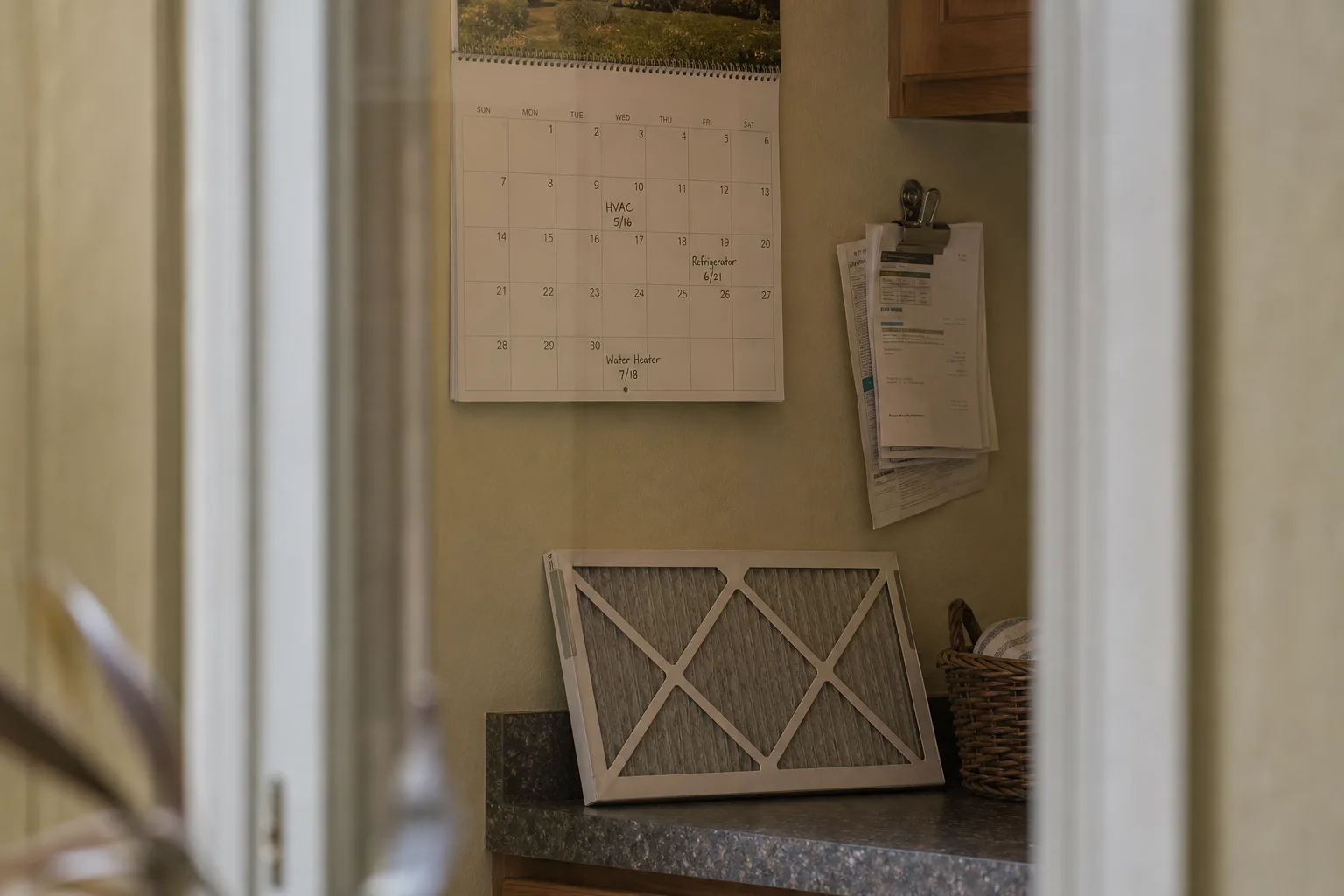
A furnace filter that runs eleven months instead of three does not announce itself. The blower works harder, the bill drifts up by an amount too small to notice in any single month, and the failure, when it arrives, arrives in February. That is the real test of a maintenance schedule: not whether it is sensible on paper, but whether anything in it survives a busy fall. Three approaches are in common use, they fail in different places, and one of them has already been written for you by a county health department, a water utility, or a state fire code.
The calendar schedule, and the month it quietly dies
The calendar approach assigns tasks to dates: gutters in November, water heater flush in spring, dryer vent every fall, filters on the first of alternating months. Its advantage is that it needs no judgment at the moment of action, which is exactly why it works for tasks with no warning signs, the ones where the first symptom is the failure. Its weakness is uniform: every task carries equal weight, so the reminder for the smoke detector battery looks identical to the reminder for the septic pump-out. After the third month of dismissing a notification, the household has trained itself to dismiss all of them, and the schedule is over without anyone deciding to end it.
The fix is not more discipline. It is fewer dated items, ideally under a dozen a year, with everything else moved onto a trigger. A calendar that carries only the tasks with legal deadlines, warranty conditions, or seasonal cutoffs stays credible, because every entry on it is one that costs money to skip. Households that keep a calendar for years tend to have pruned it aggressively rather than built it out.
The meter schedule, where the bill does the reminding
The second approach ties maintenance to a measurement rather than a date: equipment runtime, a pressure reading, a filter differential, or the utility bill itself. It matches effort to actual use, which matters more than most schedules admit, since a heat pump in a coastal house running nine months a year and one in a mild climate running four do not wear at the same rate. A furnace filter changed on runtime rather than the first of the month gets changed more often in a cold snap and less often in a mild October, which is the correct behavior in both cases.
The billing history is the most underused trigger in a house. Most utilities publish twelve or twenty-four months of usage in the customer portal, normalized against degree days, and a consumption line that rises while the weather did not is a maintenance signal with a dollar figure already attached. The Department of Energy tracks residential energy consumption and the equipment behind it, and the general shape holds: air handling, water heating, and refrigeration carry the load, and all three degrade quietly rather than suddenly. A month-over-month comparison, checked four times a year, catches the drift long before a technician does.
What the meter approach cannot do is remind you about anything that does not draw power or move water. Caulking, roof flashing, tree clearance, and dryer lint have no meter. That is why this method works as half a system, not the whole one.
The schedule your jurisdiction already wrote
The third schedule is not optional and it varies more by geography than anything else in home upkeep. A septic system may face a pumping interval set and enforced by a county health department, with a required record on file, in one place, and nothing but a manufacturer's suggestion twenty miles away across a county line. Irrigation systems tied to a municipal water main frequently require an annual backflow assembly test performed by a certified tester, with results filed with the utility rather than kept in your drawer, and the penalty for missing it is usually a service shutoff rather than a fine. Neither deadline appears on any generic seasonal checklist.
The pattern repeats across regions with different hazards. Wildfire states set defensible space clearance requirements around structures with seasonal cutoff dates, and inspections are real. Coastal counties attach shutter, opening protection, and roof tie-down conditions to wind mitigation credits that only pay if an inspection is current. Cold-weather cities put sidewalk snow clearance on the property owner within a stated number of hours after a storm ends. Rental properties add another layer entirely, with local habitability inspection cycles that run on the jurisdiction's calendar, not yours. The practical step is to spend one hour, once, on the county and utility websites identifying which of these apply to your address, then put only those on the dated calendar.
Warranty and insurance conditions, which are schedules in disguise
Manufacturers and insurers impose maintenance timing without calling it that, and both attach consequences that are hard to reverse after the fact. Many HVAC and water heater warranties condition coverage on documented annual service by a licensed contractor, which means the invoice matters as much as the work, and a homeowner who did the maintenance correctly but kept no receipt is in the same position as one who did nothing. Roof warranties often void on unapproved penetrations, so the satellite mount or solar attachment installed without the manufacturer's sign-off changes the coverage permanently.
Insurance runs on the same logic from the other direction. Policies increasingly ask for proof of upkeep on the systems that generate the most claims: supply lines, water heaters past a stated age, and roof condition. Some carriers offer premium credits for verified mitigation work, particularly wind and water shutoff devices, and those credits are typically documented at inspection rather than granted on description. The order matters here in a way it does not elsewhere: the inspection or the approval comes before the work, and a job completed first can rarely be credited afterward.
The hybrid that actually holds
The version that survives combines all three and keeps each one small. Mandated deadlines go on a dated calendar, because those are the ones with an outside enforcer and a real cost. Equipment items go on triggers: filter differential, runtime hours, or a quarterly look at the utility portal, checked at the same sitting so it becomes one habit rather than six. Everything remaining goes on a seasonal walk, twice a year, where the household looks at the roof edge, the grade around the foundation, the caulk lines, and the dryer duct, and writes down what changed since last time. That written record is what converts observation into evidence when a warranty or a claim asks for it.
The payback question is worth answering honestly rather than assuming it. Filter changes and duct clearing show up in consumption within a billing cycle or two and are easy to verify. A water heater flush shows up over years, in equipment life rather than usage, and is better justified as replacement deferral than as savings. Knowing which category a task belongs to is what keeps the schedule from collapsing under items nobody can see a reason for.
Start with the address rather than the house. Find out what your county, water utility, and carrier already require, put those dates down first, and let the meter and the seasonal walk carry the rest. A schedule with eight enforceable entries and two standing habits outlasts a forty-item spreadsheet every year.