Removing a Load-Bearing Wall? How One Household Told the Real Expert From the Plausible One
A couple opening up a 1961 split-level got two confident answers about the same wall. The difference showed up in a stamp, a scope letter, and a permit record at resale.
Anneliese Brandt825 words
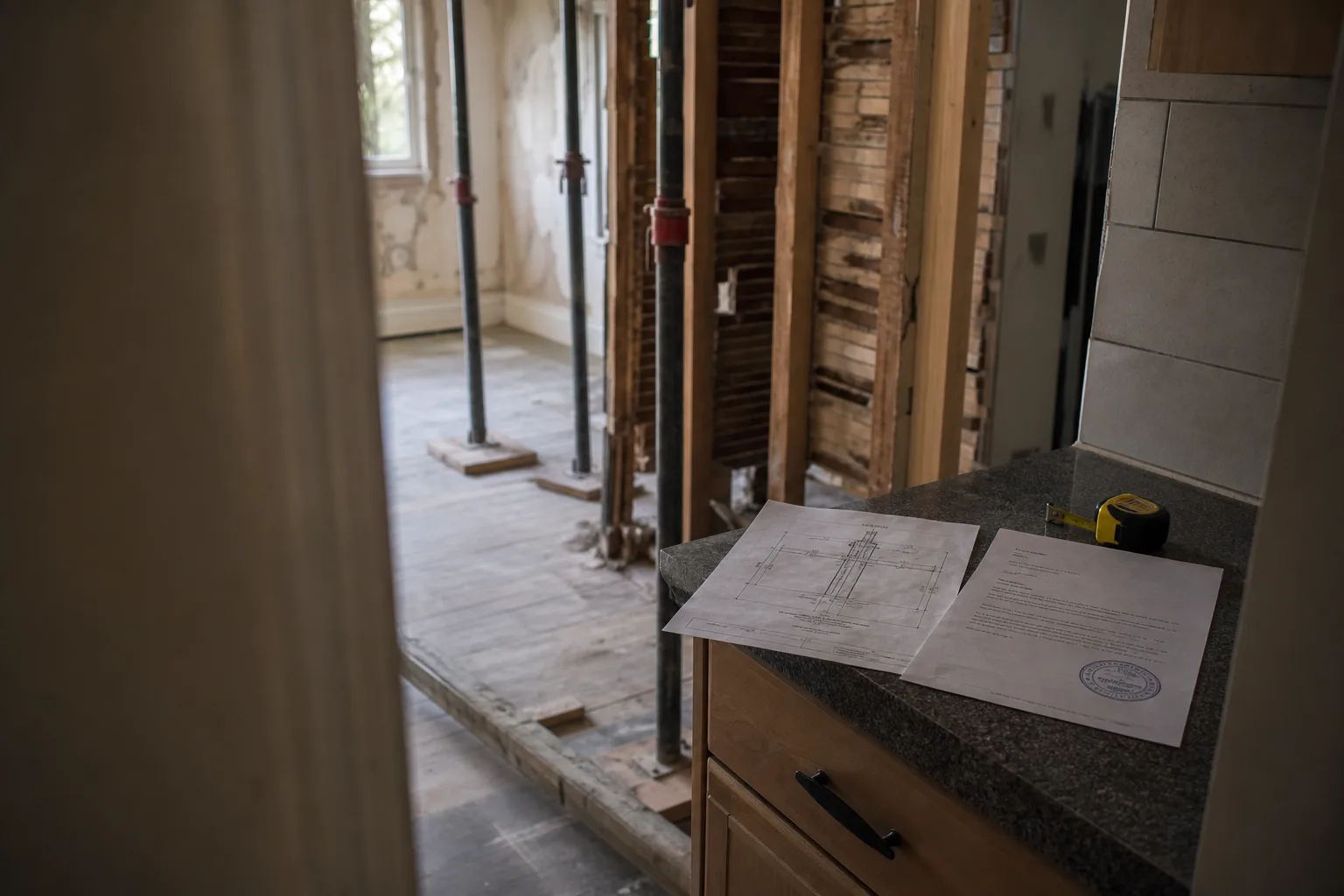
The wall was thirteen feet of plaster between a kitchen and a living room in a 1961 split-level, and two people looked at it within the same week. A design-build contractor said it was almost certainly not carrying anything, offered to open it up and find out, and quoted a number that assumed he was right. A structural engineer, reached through a neighbor, said the roof framing above suggested otherwise and declined to guess further without measuring. Both men were confident. Only one of them was going to be responsible for the answer in writing.
Two answers to one question, and only one of them was signed
Confidence is the cheapest thing in professional services, and it costs nothing to produce. The contractor's opinion was free, delivered standing up, and revocable the moment the ceiling sagged. The engineer's opinion cost a fixed fee for a site visit and a letter, took nine days, and arrived on paper carrying a seal and a license number. That distinction is the whole of the matter. A signed and sealed document ties a named individual, licensed by a state board with the power to discipline him, to a specific structural claim about a specific house. Talk does not do that.
The wall was carrying load. It supported a ridge beam through a bearing point the original plans had never shown, and the engineer's letter specified a flush beam, two engineered posts, and a footing detail under the slab. The contractor's version, executed as proposed, would have opened the wall and discovered the problem after demolition, which is the most expensive moment to discover anything. Demolition is the step that cannot be undone. Everything ordered after it is ordered under pressure, with a family sleeping around an open ceiling.
What the license certifies, and what the household had to check itself
A professional engineer's license is issued by a state board, renewed on a cycle, and searchable online by name or number, usually in under two minutes. The couple checked it, and they checked the second thing that matters, which is whether the license was current in their state rather than the neighboring one where the engineer's letterhead listed an office. They also asked for a certificate of professional liability insurance, sent directly by the carrier's agent rather than forwarded as a screenshot. None of this was adversarial. Competent professionals expect these questions and answer them in a day.
The Federal Trade Commission oversees unfair and deceptive practices in the sale of consumer services, which is the backstop when a provider claims a credential he does not hold. It is a backstop, not a screen. The screen is the state board's public register, the carrier's certificate, and a written scope, all obtainable before any money moves. A household that runs those three checks has done more diligence than most institutional buyers manage on a small engagement, and it takes an afternoon.
The scope letter decided who owned the problem
The engagement letter was two pages and it did the quiet work. It named the deliverable, a sealed letter and a framing detail sufficient for permit submission. It named what was excluded, which was construction observation unless separately engaged. It set the fee, the schedule, and the condition that the engineer would review the contractor's shop ticket for the beam before it was ordered. That last clause is the one that earns its keep, because a beam ordered to the wrong length is not returnable and a beam ordered correctly is not memorable.
Sequence followed from the scope. The engineer's letter came first, the permit application second, the contractor's revised bid third, and demolition fourth, after the inspector had seen the plan and the temporary shoring was in place. The contractor who had offered to open the wall and find out bid the engineered version too, priced it higher, and did the work well. He was not a bad builder. He was simply being asked, at the start, to render an opinion that no builder is licensed to render.
What a buyer sees four years later, and what a buyer never sees
The beam is invisible. Nobody walking through an open kitchen credits the flush header, and no appraiser assigns a line item to a bearing point that behaves. What is visible is the permit history, which a buyer's agent can pull, and the finaled inspection card, and the engineer's sealed letter sitting in the disclosure folder with the appliance manuals. Unpermitted structural work does the opposite: it surfaces in inspection, it invites a retention demand at closing, and it turns a clean sale into a negotiation about a wall that has stood fine for years.
The fee for the letter was a small fraction of the project and it bought two separate things, a house that holds up and a file that closes a sale without argument. Plausible was free and would have been discovered from underneath a torn-open ceiling.