Quoted an Hourly Rate? What the Fee Is Actually Measured Against, Week by Week
An hourly rate, a flat fee and a contingency percentage each price a different unit of work. Here is how to read the engagement letter, the monthly bill, and the tax line underneath it.
Douglas Mackenzie1,034 words
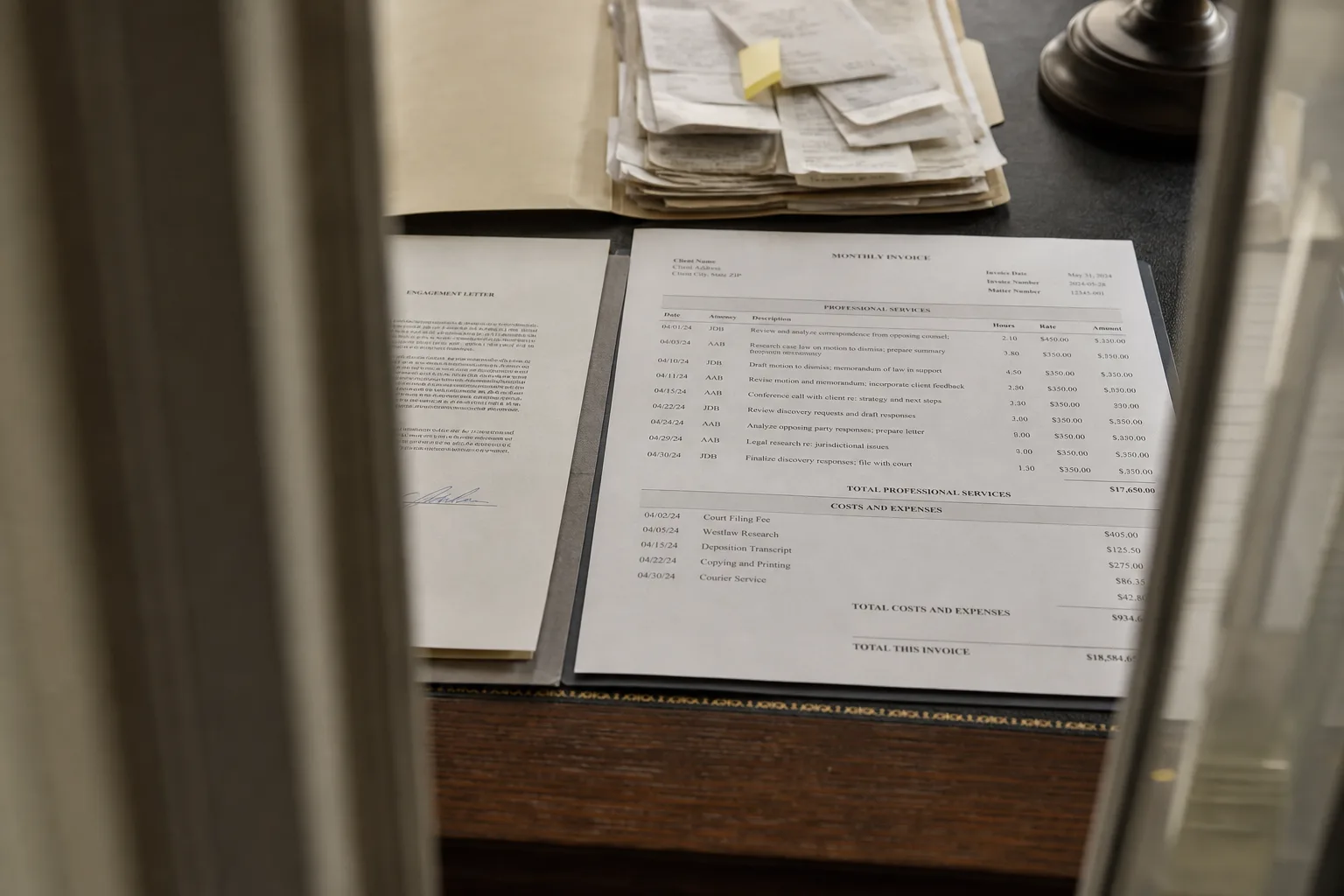
A rate is not a price. When an attorney says three hundred and fifty an hour, or four thousand flat, or a third of the recovery, the number is only half the quote; the other half is the unit it attaches to, and that unit is defined in the engagement letter rather than in the conversation you had on the phone. Most fee surprises are not overcharges. They are a client who priced the hour and an office that priced the matter, or the reverse, discovered in month three when the second invoice arrives and looks nothing like the first.
Find the unit before you argue about the rate
There are three common units and they behave differently under pressure. An hourly rate prices attention, so anything that consumes attention (a call from the other side, a document dump, a continuance) increases the bill without anyone deciding to spend more. A flat fee prices a defined output: an incorporation, a will package, an uncontested filing, a single hearing. A contingency prices a result and shifts the risk, which is why it is usually paired with a separate obligation for costs. Ask which unit you are buying, then ask what falls outside it, because the outside is where the money moves.
The boundary question matters more than the rate for a simple reason: a flat fee that covers the drafting but not the response to an objection is an hourly matter wearing a flat fee's clothes. Get the exclusions named. In a transactional matter that usually means opposing counsel's revisions, title problems, and anything that turns discretionary review into a contested proceeding. In litigation it means depositions, experts, appeals. A competent office will tell you plainly, and will often quote the base engagement flat and the foreseeable extensions hourly, which is a more honest structure than a single number that has to survive every contingency.
What the ordinary week looks like on the bill
Week to week, an hourly matter is made of small entries. Most firms bill in tenths of an hour, so a six-minute increment is the smallest thing that can appear, and a two-minute phone call and a five-minute email each arrive as a tenth. That is not padding; it is the billing convention, and the engagement letter should say which increment applies. Ask who does what. Paralegal time at a lower rate doing document assembly is the arrangement you want, and an associate rate on routine correspondence is worth raising early, politely, while it is still a pattern rather than a total.
Then there are costs, which are not fees at all. Filing fees, service of process, court reporters, expert retainers, records requests, and travel are advanced or billed through, and they land on the same statement as the legal work without being priced the same way. Read the statement for the split. What you paid up front usually sits in a client trust account and is drawn down against approved invoices, which means the retainer is your money held for your matter until the work is billed, not a payment already made. Monthly statements are how you watch that balance fall.
The rules sitting behind the number
Fee arrangements are not purely private contract. Every state's rules of professional conduct, administered through the state bar and ultimately the state's highest court, require that a fee be reasonable and that its basis be communicated to the client, ordinarily in writing and preferably before the work begins. Contingency agreements carry stricter formalities almost everywhere: a signed writing, the percentage stated, the treatment of costs spelled out, and a closing statement showing the arithmetic of the distribution. Certain matters cap or forbid contingency entirely. Client funds held in advance are subject to trust-accounting rules with their own recordkeeping obligations, which is why refunds of unearned fees are a defined right rather than a courtesy.
Two practical protections follow. First, you are entitled to an itemized accounting of what was billed and what was earned, and asking for one is routine rather than adversarial. Second, most state and many county bar associations run fee dispute resolution or arbitration programs, often free or low cost, which resolve billing disagreements without a lawsuit and without ending the underlying representation badly. Knowing that the program exists changes the tone of the conversation in month three. It is a lot easier to ask a question about a line item when both sides understand where the question would go next.
The tax line the invoice has to support
Deductibility does not follow the fee; it follows the matter. Legal fees ordinary and necessary to carrying on a trade or business are generally deductible against that business, reported on Schedule C or the relevant entity return. Fees incurred to acquire, defend, or perfect title to property are generally capital, added to basis, and recovered on sale or through depreciation rather than in the year paid. Most personal legal fees have not been deductible as miscellaneous itemized deductions since the 2017 law suspended that category. The Internal Revenue Service is responsible for how these characterizations are applied, and the character is fixed by the nature of the underlying claim.
Which is why the invoice narrative is a tax document. One engagement often contains several characters: a lease dispute on a rental (business), a boundary question that perfects title (capital), and an estate planning conversation folded into the same meeting (personal). If the entries read "attention to matter," nobody can allocate them three years later. Ask at the outset for time entries described by task and, where the matter is genuinely mixed, for separate matter numbers and separate invoices. That single request at the engagement stage is worth more than any negotiation over the hourly rate.
Keep the engagement letter, every invoice with its narratives, the proof of payment, and any closing statement together in one place, organized by matter and by year, because a deduction taken this April may be examined well after the file is closed and the attorney has moved on. The rate you negotiated is a single conversation. What the rate was measured against, and what your own records say it bought, is the part that keeps working.