Cooking for a Crowd This Season? What the Donation Rules and the Deduction Actually Cover
Seasonal surplus, date labels, liability protection for donors, and the paperwork that has to survive three years of filing cabinets.
Douglas Mackenzie964 words
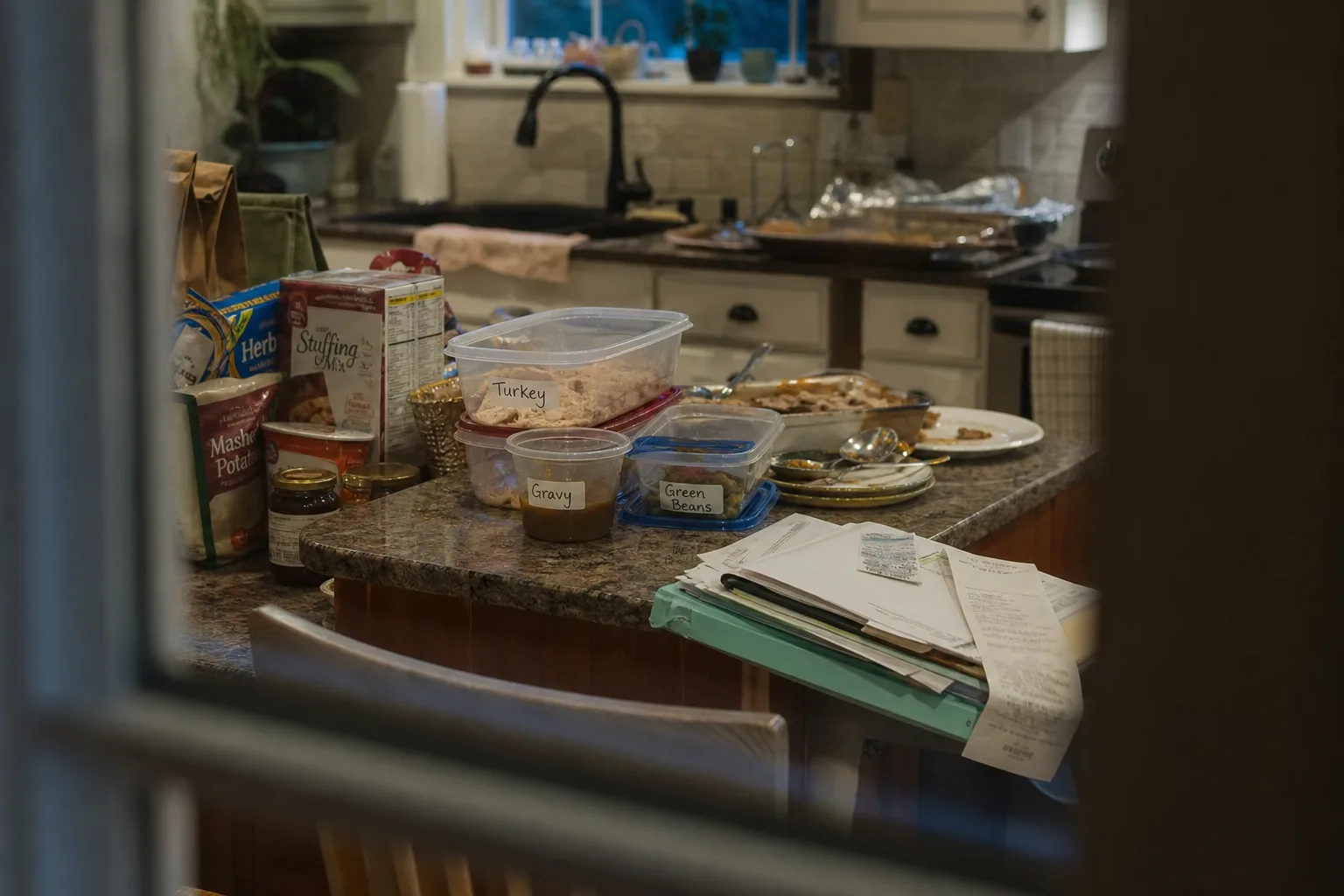
The waste curve in a household kitchen is not flat across the year, and anyone who has run a big holiday table more than twice already knows where it bends. Buying happens in one compressed week, cooking happens in one day, and the surplus arrives all at once, in quantities that no refrigerator was sized for. What follows is a sequence, and the order matters: what you can still safely give away has to be decided before the food sits out, the paperwork has to be gathered at the moment of handoff, and the tax question gets answered months later using records you either kept or did not.
The date on the package is not the deadline you think it is
Most of the seasonal discard pile is thrown out on the strength of a printed date that carries no legal force. The Food and Drug Administration oversees labeling for the majority of packaged foods, and outside of infant formula there is no federal requirement that a manufacturer print a date at all. Industry has converged on standardized phrasing, with "Best If Used By" signaling quality rather than safety, but the phrasing is voluntary and the interpretation is yours. Someone who has cleaned out a pantry in early January several times learns to sort by category, since shelf-stable starches, canned goods and unopened dairy each behave differently.
The practical habit is to separate the two questions before the holiday, not during the cleanup. Anything genuinely past its useful life goes out early, which frees the shelf space that would otherwise force good food into a crowded second refrigerator or onto a counter. Anything with real life left gets grouped where it can be seen. This sounds fussy until you have watched twenty dollars of unopened cheese die behind a roasting pan, and it is the single step that most reliably shrinks the pile before any donation question arises.
Liability protection exists, and it covers more donors than people assume
The reason most people give for not donating surplus food is fear of being sued, and the federal answer to that fear has been on the books since the mid-1990s. The Bill Emerson Good Samaritan Food Donation Act extends liability protection to people and organizations who donate apparently wholesome food in good faith to a nonprofit that distributes it to the needy. Congress amended the framework in recent years to cover donations made directly to individuals in some circumstances, and to address food sold at a reduced price rather than given outright. Gross negligence and intentional misconduct are excluded, which is the whole of the catch.
What that protection does not do is override the receiving organization's own rules, and the experienced donor calls first. Many food pantries will not take home-prepared dishes, some accept only commercially packaged items, and refrigerated capacity is tight in the last week of December. The call takes four minutes and prevents the loaded car trip that ends with everything coming home again. Ask what they can accept, what hours they receive, and whether they issue a written acknowledgment on the spot.
Which of it produces a deduction, and which of it simply does not
Here the sequence turns unforgiving, because the tax treatment is fixed at the moment of the gift and cannot be improved afterward. A household donating food to a qualified charity is making a noncash charitable contribution, deductible only if you itemize, and the deductible amount for purchased food is generally constrained by what you paid rather than by any generous retail valuation. Your labor is worth nothing on the return: the hours spent cooking, sorting and driving are not deductible, though mileage driven in service of the charity is allowed at the statutory charitable rate, which is far lower than the business rate.
Two other categories fail cleanly and are worth knowing in advance. Food given directly to a neighbor, a family in need or an individual you found through a mutual aid group is a personal gift, not a charitable contribution, however useful it was. And a contribution to an organization that is not a qualified charity produces nothing, so check the recipient's status through the IRS exempt organization search before you count on it. Businesses that donate food inventory sit under a separate and more generous rule, with a percentage-of-income cap and its own valuation math, which is a conversation to have with your preparer before year end rather than in April.
The records that have to survive three years in a drawer
Substantiation is where otherwise legitimate deductions collapse, and the requirements scale with size. Any monetary or noncash gift needs a record from the organization or a reliable written record of your own showing the date, the recipient and what was given. At and above the two hundred fifty dollar level, you need a contemporaneous written acknowledgment from the charity, obtained before you file, and no amount of later goodwill from the pantry cures a missing one. Noncash contributions above five hundred dollars in aggregate bring Form 8283 into the return, with its description and basis columns.
Keep the grocery receipts that establish cost, the acknowledgment letter, and a short note of what actually went out the door. The ordinary assessment window runs three years from filing, longer where a substantial understatement is alleged, so a single labeled folder per tax year is the whole system. Photograph the acknowledgment when you receive it, because thermal paper fades and a January pantry receipt is often illegible by summer.
The households that waste least in December are not the disciplined ones. They are the ones who decided in November where the surplus was going, confirmed the pantry would take it, and set aside a folder before the first bag of groceries came in.