The Meter Technician, the Installer, the Billing Analyst. Whose Record Decides Your Dispute
When you challenge a utility bill or a promised payback, the evidence that survives was usually created by someone else, on a date you cannot go back and change.
Hector Villanueva940 words
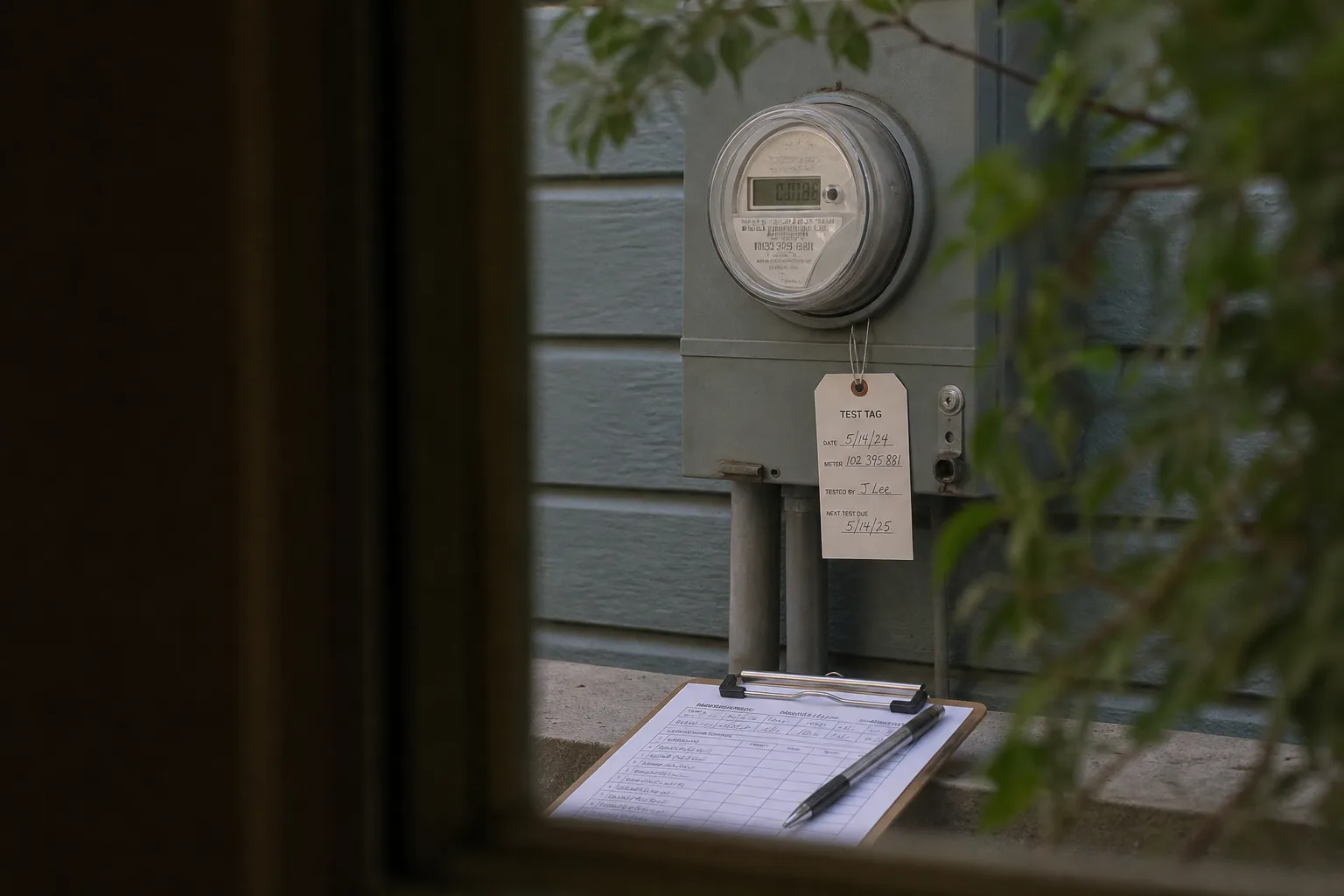
A dispute about an energy bill is rarely settled by the person who is angriest about it. It is settled by paperwork that somebody else generated, usually months earlier, usually without telling you it would matter: a meter test report, a commissioning sheet signed at the end of an install, a set of interval reads sitting in a utility database that nobody has asked for yet. The customer's own material, the notes, the photos, the recollection of what the salesperson said, tends to sit one rung lower. Knowing which rung you are standing on changes what you do first.
The records that exist before you know you need them
Three people generate most of the durable evidence in a household energy dispute, and none of them work for you. The meter technician, who tests and swaps the device and files a report with a serial number and a date. The installer, whose commissioning sheet records static pressure, refrigerant charge, combustion readings, or blower settings at the moment the equipment was handed over. The utility's billing analyst, who can pull interval data at fifteen-minute or hourly resolution and see the shape of your consumption rather than a single monthly total. Each of those records is dated, attributable, and created before there was any argument to win.
That last point is why they hold up. A record made by a neutral party in the ordinary course of their work carries weight that a reconstruction made after the fact does not, and the gap is not a matter of fairness, it is a matter of what the record can be checked against. Ask for the commissioning sheet at the end of the job, while the crew is still on site and the truck is still in the driveway. Ask for the meter test report by its date. Ask the utility for interval data in writing, referencing the account number and the billing periods in question.
What the utility can show that your own notes cannot
A monthly bill is a summary, and summaries lose the information a dispute usually turns on. Interval data shows a baseline load overnight, the step change when a heat pump switches to auxiliary strip heat, the flat plateau of a stuck element, the exact evening a new system came online. If you replaced a furnace in October and the bill jumped in January, the monthly numbers cannot separate the equipment from the weather, but the interval curve set against degree days often can. Utilities hold this data routinely. Most customers never request it, and it is generally available on request.
Two other utility-side records earn their place. A meter accuracy test, which you can usually request, produces a pass or fail against a defined tolerance rather than a suspicion. And the billing history itself, pulled as a multi-year series rather than a comparison against last month, is what lets an analyst distinguish a genuine step change from ordinary seasonal drift. Ask for the series in a machine-readable form if it is offered. The person reviewing your case will work faster from the same file you are working from, and speed matters when a billing period is about to close.
The evidence that quietly fails
A neighbor's bill proves almost nothing, because the house next door has different insulation, occupancy, thermostat habits, and possibly a different rate class. An average is worse, since the whole question is whether your particular consumption changed. Verbal savings claims from a sales conversation are hard to hold anyone to unless they were written into the contract or the proposal, which is why the proposal document, with its stated assumptions about run hours and fuel price, is worth more than any conversation you remember clearly. The Federal Trade Commission is responsible for the EnergyGuide labeling program that sets out how appliance energy claims are presented, and the label's stated assumptions are often the honest basis for a payback estimate that was pitched to you more loosely.
Photographs help when they are anchored. A picture of a nameplate with a legible model and serial number, taken before removal, is evidence. A picture of a puddle is a picture of a puddle. Screenshots of a usage portal are useful only when the account, the date range, and the units are visible in the frame. The habit worth building is simple: capture the identifying detail, not the grievance.
The steps that cannot be taken again
Some evidence has a window and then it is gone. Once the old equipment leaves the property, you cannot photograph its nameplate, read its age, or have it inspected, and haul-away usually happens the same day as the install. Once a meter is exchanged, the physical device that produced the disputed reads is out of your reach, and the technician's report becomes the only account of it. Once a billing period closes and a payment posts, some disputes shift from a correction to a refund request, which is a slower path. Photograph the old unit before it goes. Note the meter reading yourself on install day.
When the utility's own review does not resolve it, the state public utility commission takes informal complaints from customers, and its staff will ask for the same three things: dates, account identifiers, and the records held by the other side. Arriving with those already in hand is what shortens the process.
The reads you take on installation day cost nothing and take ten minutes. They are the only part of this evidence chain you control, and they are the part that turns a disagreement about a promised payback into an arithmetic question somebody can actually answer.