Buying a Piece Worth More Than It Looks? The Questions to Ask Before the Card Comes Out
Retail counter, estate dealer, auction room or online marketplace: where you buy a valuable piece decides what you can prove, insure and resell years later.
Anneliese Brandt1,009 words
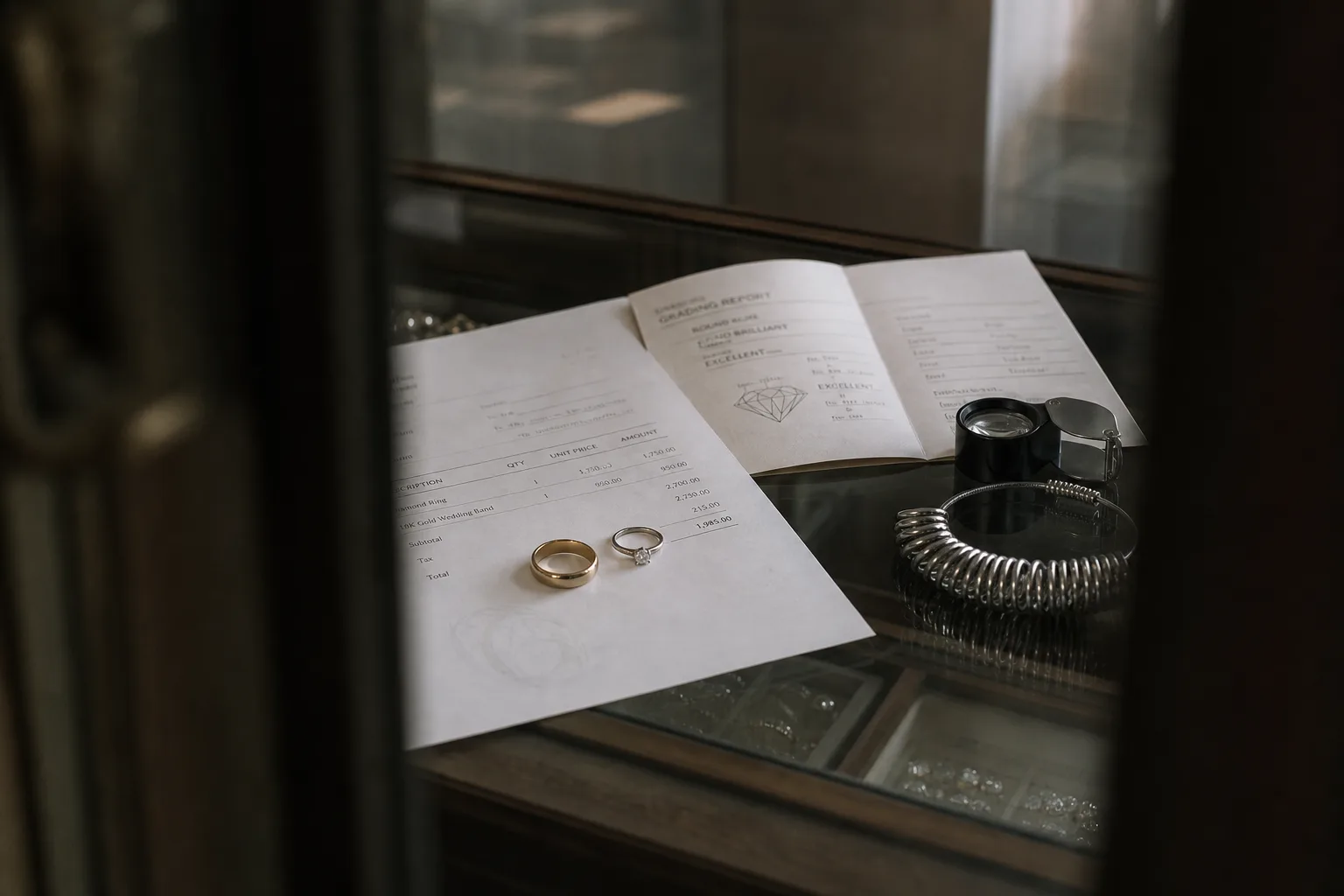
The piece that costs the most is rarely the piece that looks the most expensive. A plain band in an unmarked box can carry more metal value than a bright cluster of small stones in a lit display case, and the difference shows up years later, at the moment somebody other than you has to put a number on it. That moment is usually an insurance schedule, a divorce, an estate, or a resale. What you can prove then was decided, almost entirely, at the counter where you bought it.
Four counters, four different receipts
A retail jeweler sells you a current item with a current price, a warranty, a return window measured in days, and staff who will size and repair the piece in house. An estate or antique dealer sells you something already used, priced against what the trade paid for it, sometimes with a written description that carries real weight and sometimes with nothing beyond a line on a sales slip. An auction house sells you a lot, as described in a catalog, with a buyer's premium added on top and conditions of sale that limit what you can complain about afterward. An online marketplace sells you photographs and a seller rating.
Those four transactions can involve an identical ring. What differs is the paper trail that follows it home, and the paper trail is the part a future buyer, adjuster, or appraiser actually reads. Retail gives you the cleanest documentation and the highest price relative to what the piece would fetch back on the open market. Auction and estate purchases usually cost less and document less, which is a fair trade if you know which of the two problems you would rather have. Ask, before you pay, exactly what will be written on the invoice.
Ask what the seller will put in writing, not what they will say out loud
Spoken descriptions are generous. A stone becomes a diamond, a color becomes near colorless, a period becomes Edwardian, and none of that is attached to anything you could raise later. The useful question is narrow: will the invoice state the metal fineness, the stone type and whether it is natural or lab grown, the treatment history, the carat weight, and the presence or absence of a grading report from an independent laboratory. Sellers who can answer that comfortably will answer it in thirty seconds. Sellers who cannot will change the subject to how the piece looks on you.
Ask separately whether the appraisal offered is written by the seller. An in-house appraisal at a retail counter often states a replacement value well above what you paid, which flatters the purchase and inflates the premium on the insurance rider you are about to buy. An independent appraiser you hire yourself has no stake in the number. The Federal Trade Commission oversees how jewelry and precious metals are described and advertised to consumers, which is why terminology on an invoice is worth insisting on: the vocabulary is not decorative, it is the thing that binds.
The consequences nobody traces back to the purchase
Six months on, you call your insurer to schedule the piece. What they want is a description and a value from a source they will accept, and a purchase invoice that says gold ring with stones does not survive that request. So you pay for an appraisal, which costs real money and takes a trip, and you discover the stone is treated in a way that changes the number. Two years later the shank wears thin, and the jeweler who did not sell it to you quotes higher, or declines the work entirely, because nobody wants liability for a setting they did not build. None of that reads as a consequence of where you bought it, but it is.
The pattern repeats at resale. A dealer buying from you looks at metal weight, stone salability, brand, and documentation, in roughly that order, and pays against what he can move it for rather than what you were told it was worth. Papers do not create value, but their absence forces the buyer to assume the worst case and price accordingly. That gap, between a piece with a laboratory report and the same piece without one, is money you either spent at purchase or forfeit at sale. Choosing where to spend it is a genuine decision, and it is easiest to make on the way in.
Which steps you can still undo
Almost everything about a retail purchase is reversible for a short window, which is precisely what the higher price buys. Auction purchases are generally final on the hammer, with the catalog description as your only ground for recourse and a short window for raising it, so the reading has to happen before the bidding rather than after. Online, you have platform protection that covers a piece not matching its description, and that protection expires quickly. The irreversible acts are physical: resizing, resetting, refinishing, and laser inscription. Do the paperwork first, then alter the piece, never the reverse.
Sizing deserves particular attention, because it is the alteration people treat as trivial. Cutting down an antique shank with an engraved interior removes the engraving, and an original hallmark can go with it. Rhodium plating a warm white gold setting makes it read as modern, which is fine until a buyer who wanted a period piece looks at it. If a piece is going to be worn hard, ask whether a sizing bead or a spring insert can do the job without cutting. That question, asked at the counter, protects a value you will not test for a decade.
The best version of this purchase is unglamorous. You leave with a piece you like, an invoice specific enough to hand to an insurer, a laboratory report if a stone is carrying most of the value, and a clear answer about who will service the thing in ten years. Ask for those four before the card comes out and the counter you chose stops mattering much at all.