First Maintenance Schedule? Build It Around the Receipts You Will Need Years Later
A maintenance calendar that survives a real year is built from warranty terms, insurance conditions and the repair-versus-improvement line, not from good intentions.
Douglas Mackenzie943 words
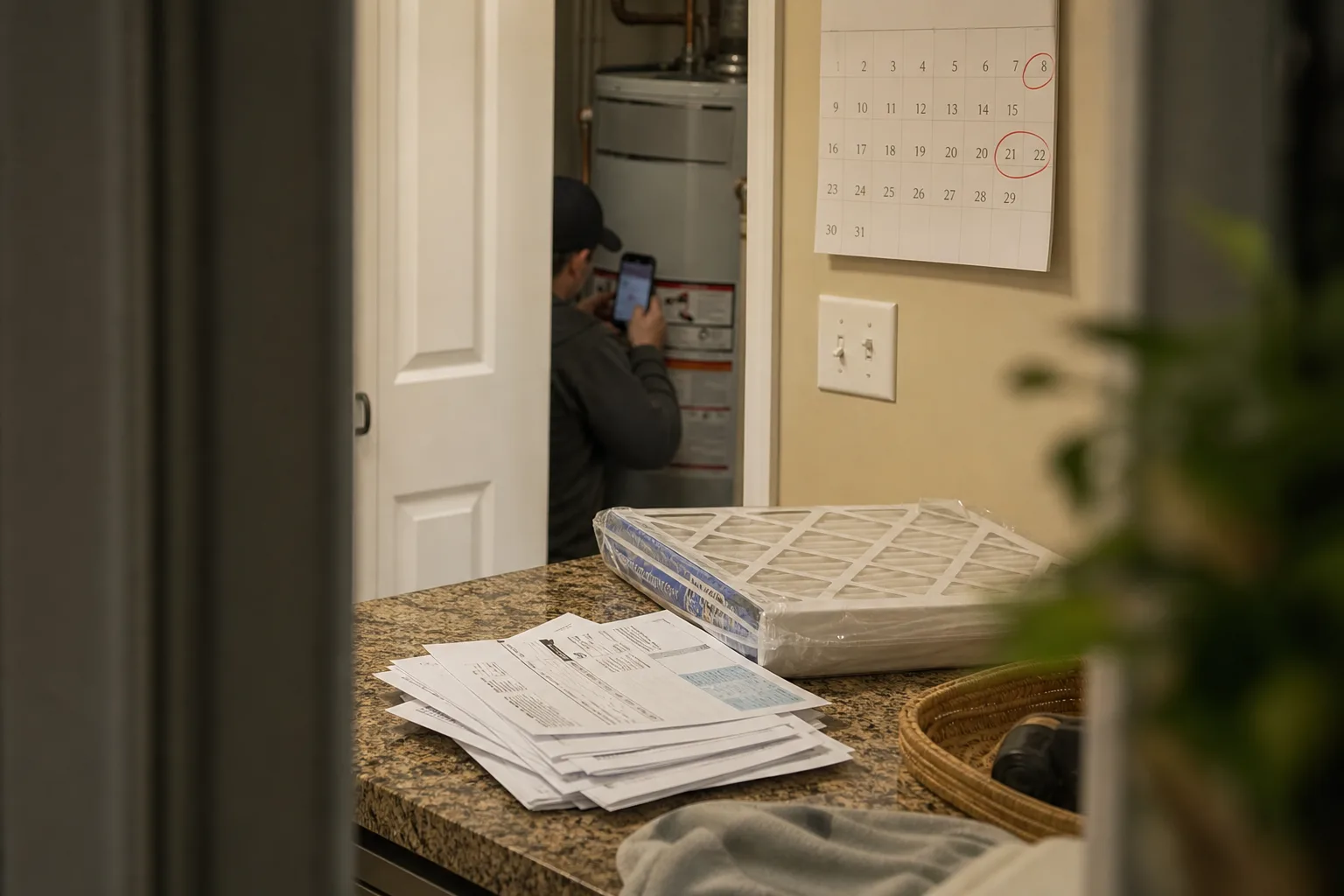
The first maintenance schedule almost everyone writes is a calendar of good intentions: gutters in spring, furnace in fall, water heater flush at some point. It fails in March, quietly, and nobody notices until something leaks. The schedules that hold are built backward, from the documents that will eventually ask questions, because a warranty administrator, an insurance adjuster and, years later, a tax preparer will each want proof that a specific thing happened on a specific date. Start with what those parties require, and the calendar mostly writes itself.
Three sets of rules already set your intervals before you pick any
You are rarely choosing frequencies from scratch. The manufacturer's warranty on a furnace, a water heater or a tankless unit typically conditions coverage on documented annual service by a qualified technician, and the coverage narrows or lapses without it. Your homeowners policy imposes a softer version of the same thing: it covers sudden and accidental damage, not deterioration you were expected to manage, so an adjuster reading a denied claim is reading for neglect. Local code adds a third layer for items like backflow preventers, septic systems and some chimneys. Copy those intervals first.
What is left after that is genuinely discretionary, and it is smaller than most first-time owners expect. Filters, dryer vents, gutter clearing, sump pump testing, grading checks, caulking, smoke and carbon monoxide detector batteries. These are cheap, they are fast, and they are the ones that fall off a calendar because nothing visibly breaks when you skip them. Group them by season rather than by system, put them on the same weekend every year, and attach them to something you already do, which is the only reliable way a chore survives a busy month.
The repair and improvement line decides when you get the money back
For a personal residence, routine maintenance is not deductible. That surprises people, and it is the point at which a first-time owner decides record keeping does not matter. It does, because the same spending splits into two categories that behave very differently. A repair keeps the property in ordinary operating condition and simply costs you money. An improvement, meaning something that betters, restores or adapts the property, is added to your cost basis, and basis reduces the taxable gain when you eventually sell. The Internal Revenue Service is the authority that sets and administers that distinction.
The practical consequence is that a new roof, a replaced HVAC system, a finished basement, new windows and an added bathroom all belong in a permanent file, while a service call to clear a condensate line does not need to go anywhere except your maintenance log. The hard cases sit between: a partial roof replacement, a compressor swap inside an existing system, a repair done as part of a larger remodel. Keep those invoices too. Deciding later with paperwork in hand is far easier than deciding now without it.
What the record has to contain to still be useful in year nine
A record that only says the date and the amount will not answer the question anyone actually asks. What you want, for every entry, is the date, the vendor's name and contact information, a description of the work in the vendor's own words, the address of the property, the amount and the method of payment. Photographs before and after cost nothing and settle arguments. If the work touched a system under warranty, note the model and serial number, because the administrator will ask for it and the label will be unreadable by then.
Storage matters more than format. Thermal receipts fade to blank within a few years, so scan or photograph anything on that paper the week you get it. One cloud folder per year, with a second folder that never gets purged for improvements affecting basis, is enough structure for a household. Name the files so they sort by date. The reason for the permanent folder is simple: the gain calculation on a sale can reach back across your entire ownership, and nobody reconstructs fifteen years of invoices from memory.
Renting out space changes the calendar and the treatment together
The moment part of the property produces income, through a rental unit, a long-term tenant or a qualifying home office, the same maintenance spending changes character. Ordinary and necessary expenses on the income-producing portion become deductible in the year paid, and improvements are capitalized and depreciated rather than simply added to basis. Allocation between personal and rental use becomes something you have to be able to show, usually by square footage or by days. That allocation is worth writing down at the time, in a note attached to the invoice.
There are also safe harbors that let smaller taxpayers expense certain routine and low-cost items rather than capitalize them, and they are worth raising with a preparer before the first full year closes rather than after. Their common requirement is unglamorous: consistent, contemporaneous records showing what was done, how often, and why it was expected to recur. A maintenance schedule you actually follow is the evidence those provisions run on, which is a rare case where the tidy habit and the tax position reward exactly the same behavior.
Write the first version narrow. Six to ten recurring items, tied to warranty and policy conditions, on two fixed weekends a year, with a photograph and a scanned invoice for each. Add to it only after a full cycle has held. A schedule that is honest about how much a household will really do, and that produces a clean paper trail while it runs, is worth considerably more than an ambitious one abandoned in March.