Cold Months, Cheap Cuts, One Oven Load. Where a Budget Week Is Actually Won
Seasonal price signals have weakened, the circular moved into an app, and the difference between a barely adequate budget week and a good one moved with them.
Anneliese Brandt1,123 words
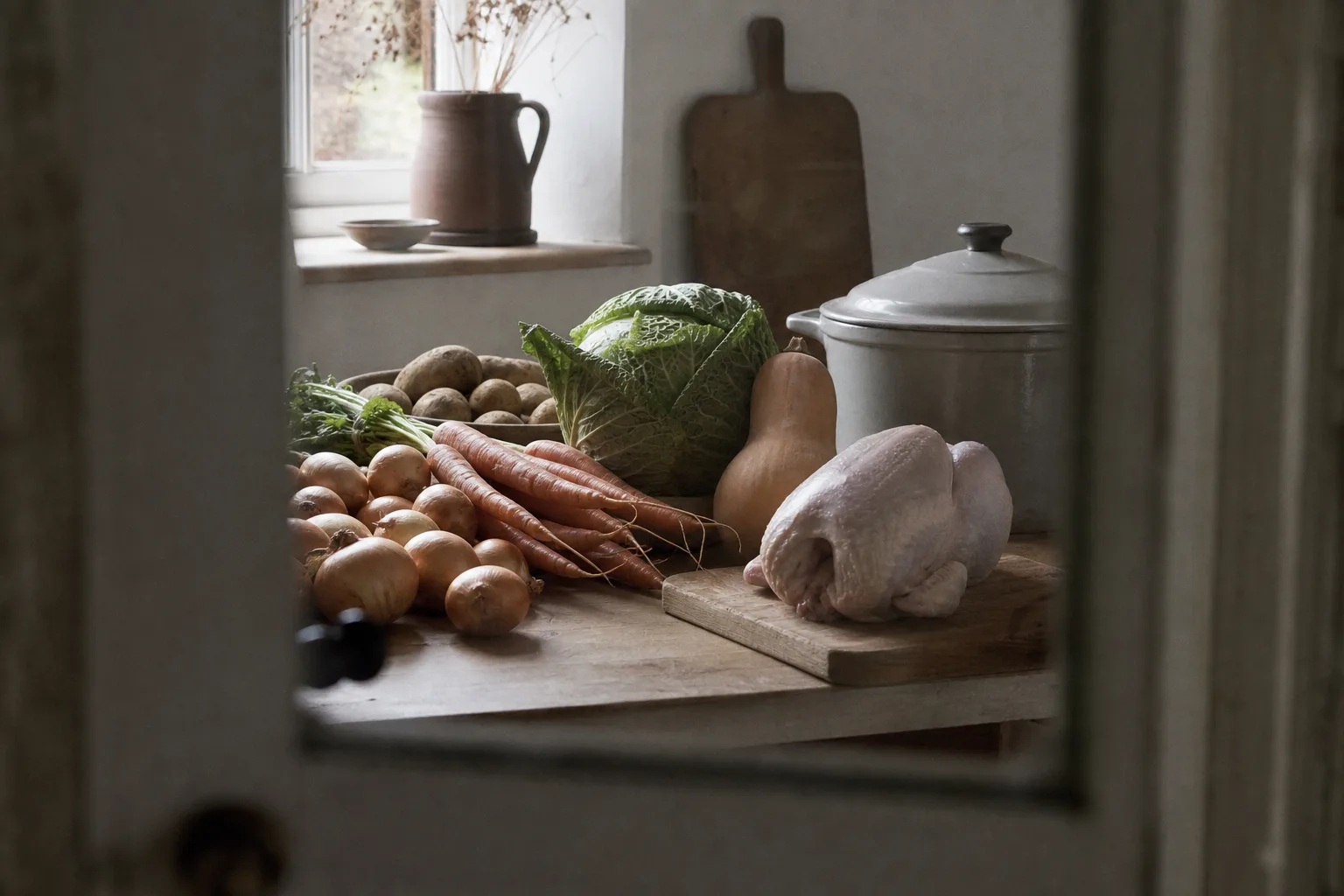
A weekly food budget is a number that can be met two ways, and only one of them survives to the following week. The barely adequate version hits the total at the register and then quietly fails on Thursday, when nothing in the refrigerator wants to become dinner and something gets ordered. The good version hits the same total, produces seven meals people actually ate, and leaves almost nothing to throw out. The gap between them is not willpower or thrift. It is sequence: what gets decided before the store, what gets decided in the store, and what can no longer be changed once the bag is in the trunk.
The season stopped setting the price, and something else took its place
For a long time the calendar did most of the work. Produce was cheap when it was local and expensive when it was not, and a shopper who followed the season followed the price. That signal has weakened. Long supply chains and imported counter-seasonal growing have flattened the curve on a great many items, so a bell pepper in January is no longer the luxury it once was, and it is also no longer the bargain it once was in August. The Bureau of Labor Statistics tracks food prices as part of the consumer price index, and the category has moved unevenly, which is the practical point: the discounts are still there, but they no longer arrive on schedule.
What did hold is storage. Cabbage, carrots, onions, potatoes, winter squash, beets and apples are cheap in cold months because they keep without refrigeration and ship without care, and that economics has not changed and is not going to. Dried beans and rolled oats behave the same way. So the seasonal instinct still works, but it now applies to a narrower list than it used to, and applying it to the whole produce aisle produces disappointment. Cook the storage crops in November because they are genuinely cheap. Buy the out-of-season pepper if you want it, and buy one.
The circular moved into an app, and that changed the order of the shop
The paper circular that came in the mail was a planning document. It arrived days before the trip, it showed the whole store at once, and it let a household build a week around whatever the loss leader happened to be. Most chains have moved that function into a loyalty app, where the discounts are personalized, sometimes require clipping before checkout, and are not always visible on the shelf tag. The practical consequence is that the planning step now happens on a phone, at home, and it happens before the list rather than during the walk. Clip first, then write the list, then shop. Reversing those two steps is how people pay full price for an item that was discounted for them.
Inside the store, the number that matters is the unit price on the shelf tag, not the package price, and cold-weather shopping is where the difference compounds. A five pound bag of onions against three loose onions, a whole chicken against a tray of breasts, a pound of dried beans against four cans: each of those is a real spread, and each requires a little labor at home to collect. That is the trade. Buying by unit price commits you to processing time in the kitchen, and a household that will not do the processing should not buy the format.
Where the good week and the adequate week actually diverge
The divergence is almost always waste, and waste is a scheduling problem rather than a moral one. Perishables have clocks that start the moment they are bought, and the clocks differ: greens have days, a whole chicken has a few days raw and longer cooked, hard squash has weeks. A good week loads the fast-clock items into the first three days and the slow ones into the back half, so nothing is racing anything. An adequate week buys the same groceries in the same amounts and cooks whatever is appealing on the night, which means the spinach is discovered on day six. Same receipt. Different outcome.
The second thing that separates them is whether one cooking session was designed to produce two meals. Roast a chicken on Sunday and the carcass becomes stock, the dark meat becomes a second dinner, and the oven that was already hot can hold a tray of squash and a tray of potatoes at no additional cost. This is the cold-month advantage, and it is the reason the same budget stretches further in December than in July. The oven is already on for an hour. Filling it is free.
Cheap cuts need time, not money, and time is the winter resource
Chuck, shoulder, shank, thighs and short ribs are inexpensive because they require two to three hours of low heat to become good, and that requirement is precisely what the cold season supplies. A braise wants a house that does not mind being warm. A pot of beans wants a burner that is going to be occupied anyway. The irreversible decision here is the purchase, not the cooking: buying a fast cut and then discovering you had time is a small loss, while buying a slow cut and then not having the afternoon is a freezer problem at best.
Freezing is the release valve, and it has a rule that gets learned the expensive way. Raw meat freezes well once and poorly twice, so the thing to do with a bulk pack is to divide it into meal portions on the day it comes home, before anything is opened for dinner. Cooked food freezes forgivingly. Braises, chilis, soups and stocks come back nearly intact, which means an ambitious Sunday is not a risk. It is inventory.
What the receipt never shows
The register total is the visible part, and like a kitchen renovation, the visible part is not where the value sits. Nobody sees the twenty minutes spent portioning a pork shoulder into four bags, or the quart of stock in the door of the freezer, or the decision to buy the whole cabbage instead of the bagged slaw. What they see is that dinner happened seven times and the number held. A household running the sequence well tends to spend less on groceries and considerably less on the unplanned takeout that a failed Thursday produces, and the second saving is usually larger than the first.
Run the storage crops hard through the cold months, clip before you list, and buy the slow cut only when the afternoon is genuinely available. The rest is repetition, and repetition is what turns a budget from a constraint into a habit that no longer requires attention.