Company Adjuster, Independent, Public. Which One Your State Lets You Bring In
The three kinds of adjuster who can touch a property claim, what separates a thorough adjustment from a thin one, and how state rules and the IRS change the answer.
Douglas Mackenzie1,028 words
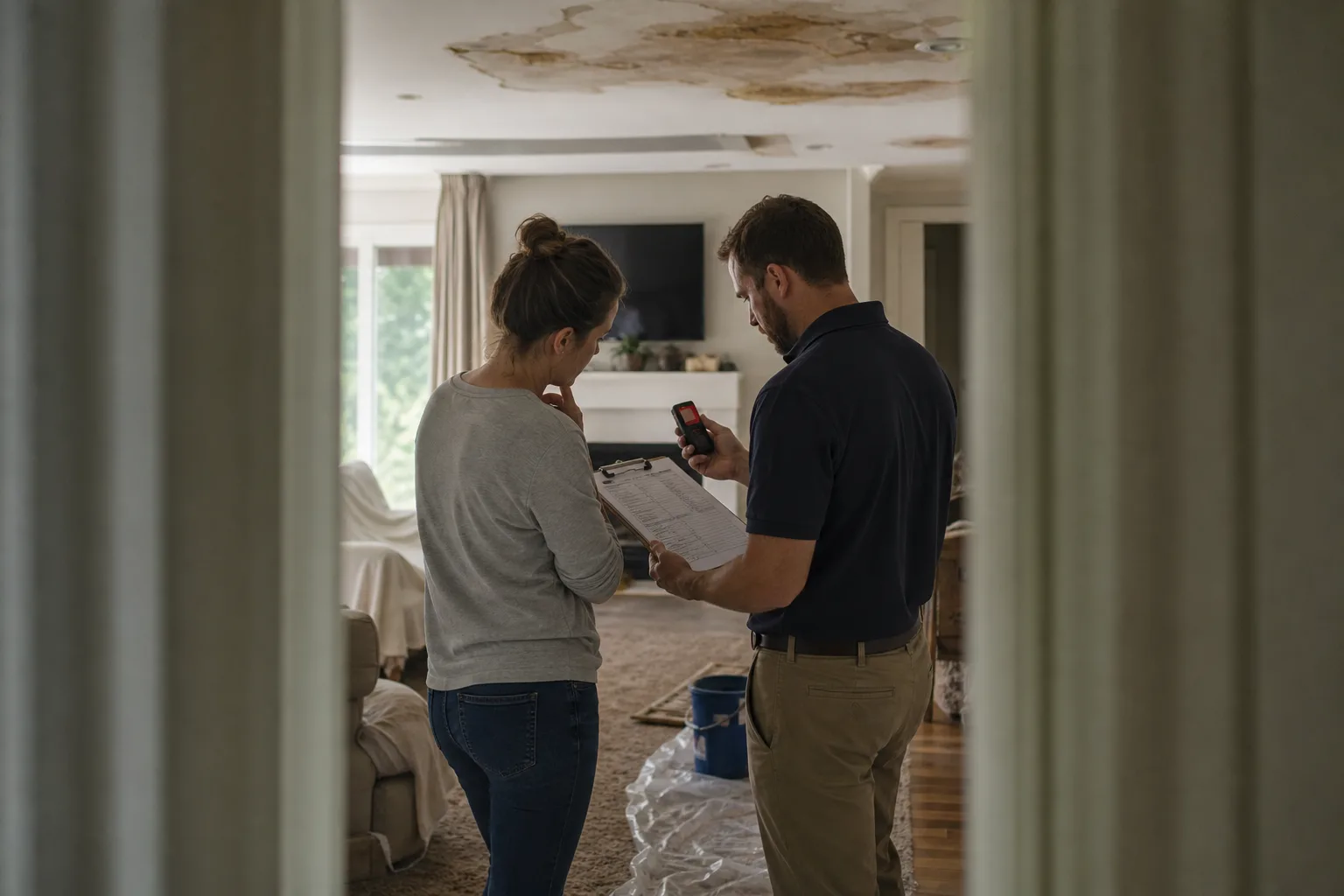
The person who arrives to look at the water stain or the stripped shingles is one of at least three possible people, and the distinction matters more than the business card suggests. One is a salaried employee of the insurer. One is a contractor the insurer hires by the file, often in volume after a storm. One is licensed by the state and hired by you, paid out of what you recover. The scope they write becomes the budget for the repair, and the budget is very hard to move once the first check clears.
Who the adjuster answers to, and what that changes in practice
A company adjuster carries the insurer's authority, which can be an advantage: decisions get made on the spot, supplements get approved without a second layer, and there is a named person who stays with the file. An independent adjuster has the same instructions but less discretion, and after a regional catastrophe may be working dozens of properties a week, often from out of state and unfamiliar with local construction. A public adjuster works for you, prepares your proof of loss, and negotiates the scope, but takes a percentage of the settlement. None of the three is automatically the right answer, and the second two are frequently layered onto the first.
There is a fourth route that costs nothing to preserve: the appraisal clause written into most property policies. When the dispute is about the amount of the loss rather than whether the loss is covered, either side can demand appraisal, each names an appraiser, and the two select an umpire. It is faster and cheaper than litigation, and it does not require you to fire anyone. The clause has a deadline buried in the policy conditions, so read it before the adjustment feels settled rather than after.
What separates a thorough adjustment from a thin one
A good adjustment produces a document you can hand to three contractors and get comparable bids from all three. It has room-by-room measurements, not square-foot averages. It identifies the material actually there, including the difference between a laminated shingle and a three-tab, plaster and drywall, solid hardwood and engineered plank. It accounts for the work that supports the visible repair: detaching and resetting fixtures, containment, drying equipment runtime, debris haul, permit fees, and the overhead and profit a general contractor charges when the job involves enough trades to need coordinating.
A thin adjustment is recognizable by what it omits rather than what it gets wrong. Carpet replaced in the one room that got wet, with no line for the hallway it runs into. Two walls of a four-wall room primed and painted. No line for matching materials across a continuous surface. Depreciation applied at a rate nobody explains and held back without a written statement of what triggers its release. The fix for all of it is the same and it is procedural: compare the estimate against an independent contractor's written scope line by line, in writing, before you accept payment as final.
The state line moves the rules more than most people expect
Public adjuster licensing is a state function, and the variation is real. Most states license them through the insurance department, require a bond, and cap the contingency fee as a percentage of the recovery. Several lower that cap for claims arising from a declared catastrophe, and several impose a waiting period before a public adjuster may solicit a homeowner after a disaster, along with a right to cancel the contract within a short window after signing. A small number of states do not license public adjusters at all, which changes who may lawfully negotiate your claim for a fee.
Other rules move with the state too. Some states have matching requirements or regulatory guidance obliging the insurer to deliver a reasonably uniform appearance across a continuous surface, which decides whether you get one slope of roof or the whole roof. Some set statutory deadlines for acknowledging a claim, completing the investigation, and paying undisputed amounts. Appraisal is mandatory in some jurisdictions and restricted in others. Proof of loss deadlines, and whether the insurer must supply the blank form, also vary. Your state's insurance department publishes all of this, and the call takes ten minutes.
The records that have to survive until the IRS asks
Insurance recovery and tax treatment are two separate calculations, and the second one outlives the first by years. The IRS is responsible for how casualty losses and insurance proceeds are reported, and under current federal rules a personal casualty loss is generally deductible only when it arises from a federally declared disaster, subject to a per-event floor and an income-based limit, reported on Form 4684. A handful of states never conformed to that restriction, so a loss that is worthless on the federal return may still reduce state tax. Check both, separately.
The more common surprise runs the other way. If the proceeds exceed your adjusted basis in the damaged property, the excess is a gain, and deferring it depends on reinvesting in replacement property within the statutory window under the involuntary conversion rules. That calculation needs your original purchase documents, every improvement receipt going back to the date you bought, the adjuster's scope, the depreciation schedule, the recoverable depreciation release, and the final settlement statement. For a rental, add the split between repairs you deduct now and improvements you capitalize and depreciate, because the claim recovery reduces basis either way.
Keep that file as a single set, scanned, with the public adjuster's fee agreement and invoice in it. The fee is not deductible on a personal residence claim, but it reduces the net recovery and belongs in the arithmetic. On an income property it is an expense of the property and it needs the same proof as any other.
The sequence that works is unglamorous and it holds everywhere: read the appraisal and proof of loss clauses in week one, check your state's public adjuster rules before signing anything, get one independent written scope to measure the carrier's estimate against, and file every document the moment it exists rather than reconstructing it in April three years later.