Throwing Out Food You Meant to Cook? What Changed on the Label and in the Fridge
Most household food waste comes from a handful of repeated moments, and the fixes that hold are the ones you can measure against last month's trash.
Hector Villanueva1,066 words
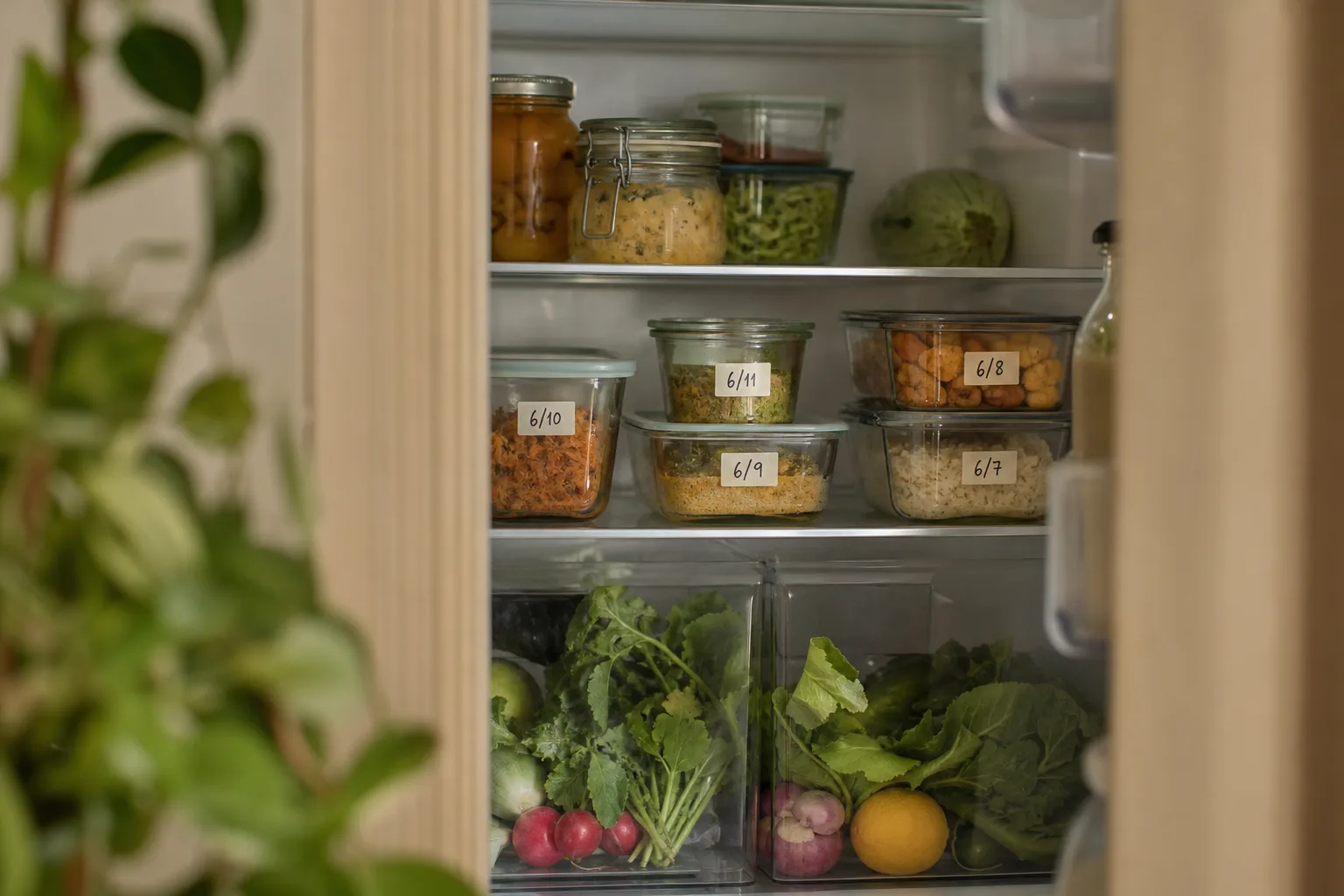
A household that throws out food is rarely careless in the way the phrase suggests. The loss happens in a small number of repeated moments: the bag of greens bought on a Sunday for a week that turned out differently, the half pound of ground meat pushed to the back of the second shelf, the container of leftovers that was never going to be eaten on day four and was never frozen on day two. The total is the sum of those moments, not a character flaw, and it responds to sequence more than to resolve.
Find the three places it actually goes, before you change anything
Before buying a vacuum sealer or redesigning the shopping list, spend two weeks keeping a running note of what gets thrown away and what state it was in when it went. Not weights, necessarily, though weights are better. Just the item, the day, and whether it was raw, cooked, or opened. Almost every household finds the same shape: fresh produce bought with intent, protein thawed on a night the plan changed, and cooked food that outlived its appetite. Those three categories need three different interventions, and buying less of everything addresses only the first.
The audit matters because it tells you where the payback is. If the losses are overwhelmingly produce, then a smaller, more frequent shopping pattern does real work, and the freezer does almost none. If the losses are cooked food, then the freezer is the whole answer and the shopping pattern is beside the point. Treating the audit as optional is the most common reason a waste-reduction effort stalls after six weeks: the effort went to the wrong category, nothing visible changed, and the habit lost its justification.
What changed on the label, and why it mattered
For decades, package dates were a mess of competing phrases: sell by, use by, best by, enjoy by, expires on, each meaning something slightly different and most of them meaning quality rather than safety. Industry groups pushed a voluntary consolidation toward two phrases, with best if used by signaling peak quality and use by reserved for the narrow set of products where the date is genuinely about safety. The Food and Drug Administration oversees labeling for most packaged foods and has encouraged the shift toward the simpler language, which is now common on shelves.
The practical consequence is that a date on a box of crackers, a jar of sauce, or a carton of shelf-stable broth is a manufacturer's quality estimate and not an instruction. Infant formula is the exception that proves the rule, carrying a date that is regulated and meaningful. Learning which phrase you are looking at converts a large category of automatic discards into a judgment call you make with your eyes and nose. That single change, applied consistently to a pantry, usually removes more waste than any container system.
The other thing that changed is what happens after the bin
A growing number of states and cities have moved organic material out of the landfill stream, through commercial generator mandates, residential curbside collection of food scraps, or drop-off programs at transfer stations and farmers markets. Enforcement varies widely, and the rules often arrive with little direct notice to households, buried in a utility bill insert or a municipal website update. If your area has added collection, the practical effect is that scraps that genuinely cannot be eaten, peels, bones, coffee grounds, leave the house in a different container and stop paying landfill tipping costs.
Worth being clear about what composting does and does not accomplish. It changes the destination of waste; it does not reduce the grocery spend that produced it. A household that composts enthusiastically and still throws out two bunches of cilantro a month has solved a disposal problem and left the purchasing problem untouched. The order matters here: reduce what gets bought and cooked beyond need first, then divert the irreducible remainder. Reversing that order feels productive and costs the same money every week.
What separates a habit that holds from one that lasts a month
A barely adequate version of this work looks like buying less, freezing more, and hoping. It fails in a predictable way. Food goes into the freezer unlabeled, becomes an unidentifiable block in four months, and is discarded with more guilt than the original item would have carried. The good version adds two cheap, boring steps: a date and a name written on every frozen item, and a single designated shelf, usually at eye level, where anything on a clock lives. The shelf is the plan. Nothing else needs remembering.
The second distinction is sequencing the week by shelf life rather than by preference. Fresh fish and delicate greens are cooked in the first two days, sturdier vegetables midweek, frozen and pantry items at the end, when energy is lowest and the plan has usually collapsed anyway. Some steps cannot be walked back. Washing and cutting produce starts a clock that cannot be stopped, so it is worth doing only for what you will eat within a few days. Thawing a large package of protein commits you to cooking it, which is why dividing and freezing in meal-sized portions on the day you buy it is the move that pays.
Counting the return without flattering yourself
Measure the result the way you would measure an insulation project: against a baseline, over a period long enough to mean something. Trash bag count per week is crude but honest and requires no equipment. Grocery receipts over three months tell you whether spending actually fell or whether you simply bought different things. Expect the produce category to improve quickly, within a few weeks, because the feedback loop is short and visible. Expect the cooked-food category to take longer, because the freezer habit only pays off once you start eating from it.
One quiet side effect is worth noting. A fridge that is organized and not overfilled runs with less door-open searching and better airflow around the vents, which is a small energy improvement rather than a large one, and it should be claimed as such. The real return is the food itself. A household that cuts its discards meaningfully usually finds the gain shows up in the grocery line of the budget within a quarter, steady and unremarkable, which is exactly what a habit that has taken hold looks like.