One Kitchen Fire, Two Scopes, Six Years of Records. What the Homeowner Got Right
A grease fire, a first scope that missed the smoke, and the paperwork a homeowner kept long enough to answer questions the IRS asks years after the claim closes.
Douglas Mackenzie1,066 words
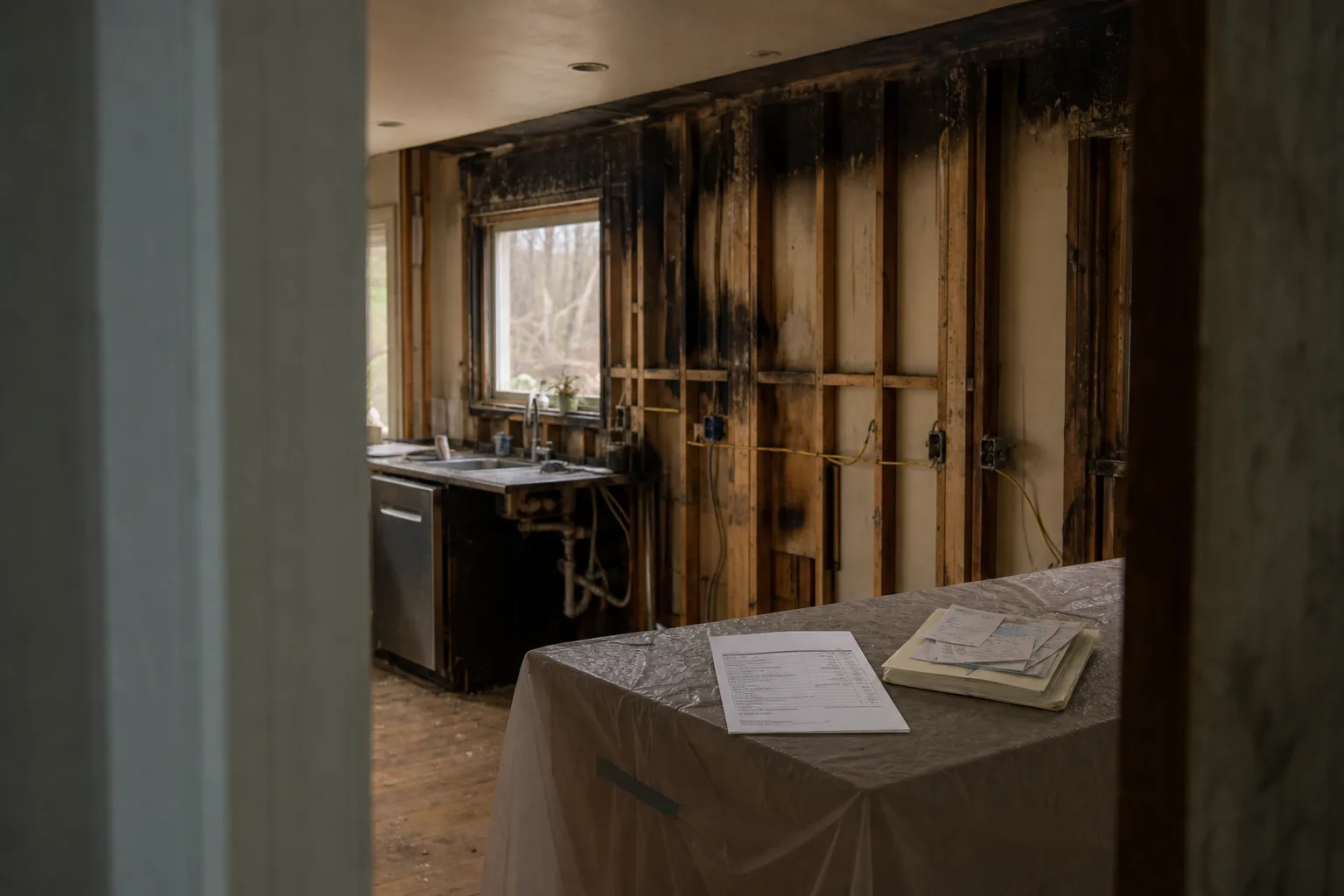
The fire itself took about four minutes. A pan of oil on a gas range, a towel too close to the burner, and a homeowner who did the correct thing by smothering it rather than carrying it to the sink. The visible damage was confined to one wall and the cabinet run above the range. The real damage, as it turned out, was smoke, which had moved through the return air duct and settled in rooms nobody had been standing in. That gap between what the eye reports and what the loss is actually made of shaped every decision that followed.
What the adjuster is doing on the first walkthrough, and what they are not
The adjuster arrived five days after the fire, carried a tablet and a laser measure, and spent most of the visit in rooms the homeowner considered untouched. That was the first useful signal. An adjuster on a first visit is building a scope, meaning a room by room list of surfaces, materials and labor operations that the carrier will price from a standard estimating database. They are not negotiating, not approving a contractor, and not deciding the final number. Understanding that distinction early stops a homeowner from arguing about price on a day when price is not yet on the table.
The homeowner asked one question that paid for itself: would the scope be shared as a document, and in what format. It would, as a PDF line item estimate. That document is the spine of the whole claim. Every later disagreement, every supplement, every contractor conversation refers back to a line in it or to a line that should have been in it and was not. Asking for it in writing, on day one, converts a diffuse dispute about fairness into a specific dispute about countable items.
Where the first scope fell short, and how the second one was built
The first estimate covered the kitchen thoroughly and the rest of the house barely. It included cabinet replacement, drywall on the fire wall, and paint in the kitchen and adjoining hall. It did not include duct cleaning, did not include sealing the framing behind the cabinets, and treated the smoke odor in two bedrooms as a cleaning line rather than a seal and repaint. The homeowner did not argue from feeling. They brought in a restoration contractor who wrote an independent estimate, documented odor readings room by room, and photographed soot deposits on the supply registers upstairs.
That package became a supplement request, submitted in writing, referencing the carrier's own line numbers and adding the missing operations beneath them. The adjuster approved most of it within two weeks and asked for justification on two items, which the contractor supplied. The lesson a homeowner can carry forward is procedural rather than adversarial: a supplement succeeds when it is a correction to a shared document, with a trade professional's observation attached, and fails when it is a complaint about the total. Judgment here is mostly knowing which form your objection has to take.
The additional living expense question, and the records nobody keeps
The family moved into a rental for eleven weeks while the kitchen and two bedrooms were rebuilt. Additional living expense coverage reimbursed the rent, the increased cost of eating out, and the laundromat, because the washer had been pulled during remediation. What it does not reimburse is what the household would have spent anyway, and that principle has a tax consequence most people never hear about. Reimbursement that exceeds the actual increase in living costs is not simply free money, and the only way to show the correct figure, years later, is a record of ordinary spending alongside the displaced spending.
This homeowner kept a single spreadsheet, updated weekly, with two columns: what was paid during displacement, and what the equivalent line had cost in a normal month. Grocery receipts, the old utility bills, the mortgage payment that continued throughout. It took perhaps ten minutes a week. The IRS is the authority that sets how insurance recoveries and living expense reimbursements are treated on a personal return, and the agency's questions are always retrospective, arriving long after the receipts would otherwise have been thrown out. Ten minutes a week is the cheapest documentation a claim ever requires.
Basis, betterment, and the folder that has to survive the next sale
The old cabinets were builder grade from the early seventies. The replacements, chosen by the homeowner, were better. The carrier paid the scope figure and the family paid the difference out of pocket, along with an upgraded range hood and a tile backsplash that had not existed before. Those out of pocket amounts are not a loss. They are an improvement to the property, and they adjust the cost basis of the home, which matters on the day it sells and not one day before. The invoices, the canceled checks and the contract change orders all belong in one place.
The insurance proceeds matter in the opposite direction, generally reducing basis to the extent they restored what was lost. Casualty loss deductions for personal property are narrow under current law, tied to federally declared disasters, so a kitchen fire of this kind is unlikely to produce a deduction at all. What it does produce is a basis story that someone will have to tell. The homeowner labeled a folder with the loss date, filed the final adjuster estimate, every supplement, the contractor's final invoice, the proceeds statements and the ALE spreadsheet, and scanned the whole thing to cloud storage.
Six years later, that folder answered a question from a tax preparer in about four minutes. The preparer wanted to know how much of the kitchen work had been reimbursed and how much the family had funded themselves, because only the second number raised the basis. Without the change orders, the honest answer would have been a guess, and a guess in that direction costs real money at closing. The claim had been settled well. The reason it stayed settled was that the paper outlasted everyone's memory of what had happened.
The judgment a homeowner builds through one loss is narrower than it feels, and more portable than it looks. Get the scope in writing. Dispute items, not totals. Track displaced spending against normal spending while both are still visible. Keep the folder past the point where keeping it seems sensible.