Buying a Piece Worth More Than It Looks? The Questions to Ask Before the Money Moves
A repeat buyer's sequence for jewelry and small valuables: which documents to demand before payment, what changed in a decade, and which records decide your tax basis years later.
Douglas Mackenzie941 words
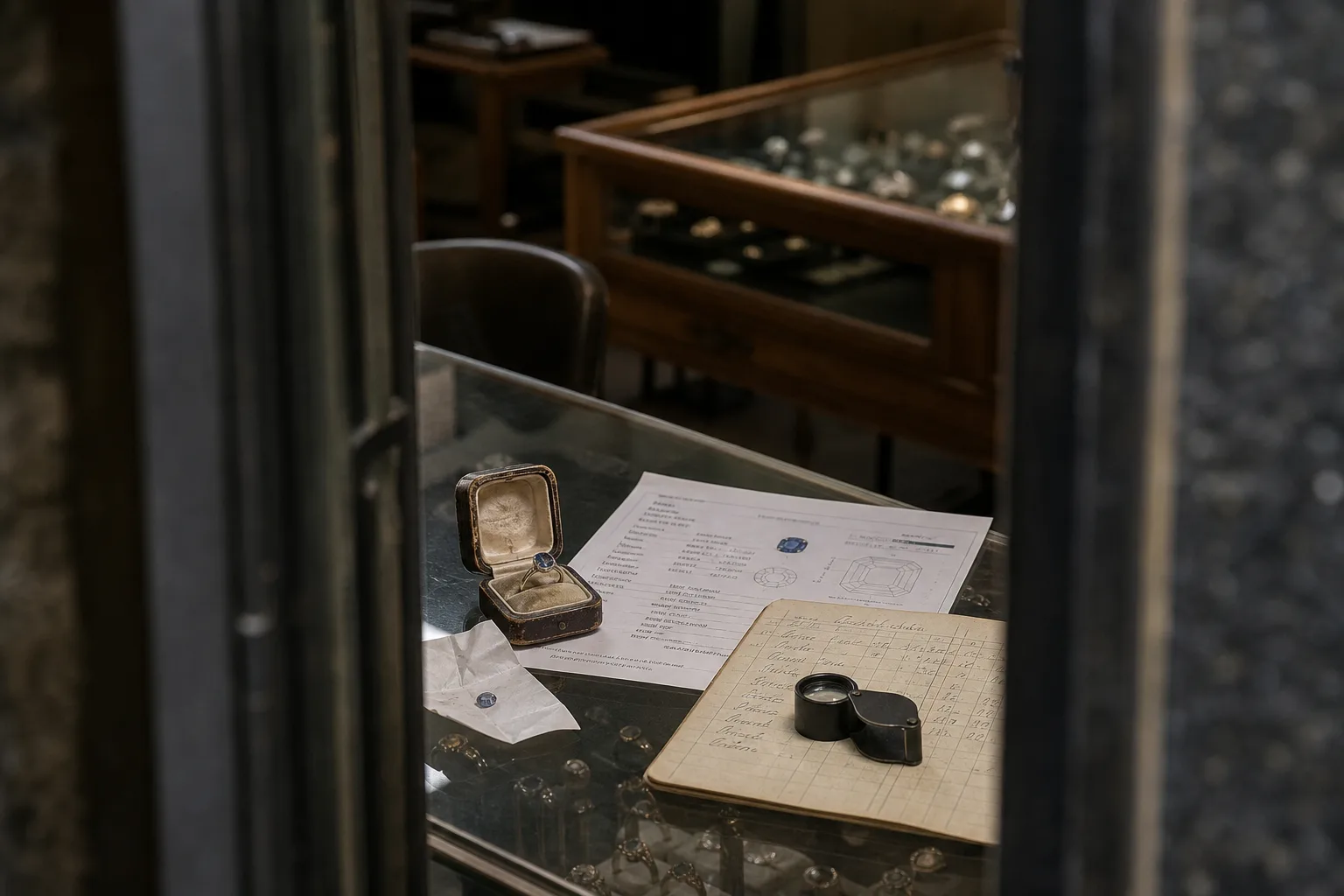
The pieces that cause trouble later are rarely the showy ones. A signed ring in a worn box, a loose stone in a folded paper packet, a watch with a service history and no papers: these are the purchases where the price is defensible, the value is real, and the record is thin. People who buy this way often, at estate sales, at auction, from dealers they have used for years, develop a fixed order of questions, and the order matters more than the questions do, because two or three of the answers stop being obtainable the moment money changes hands.
Ask what the seller can hand you, not what the seller can tell you
Every conversation about a valuable produces a story, and the story is usually accurate and almost never useful. What matters is the transferable record: a dated invoice with the seller's legal name and address, a description specific enough to identify this object and no other, the metal and stone weights, and any independent report by number. A grading report from a recognized laboratory is a document about a stone, not about a mounting, so ask whether the stone in front of you was ever removed and reset. Get the answer in writing on the invoice, before payment, because afterward it is hearsay.
The second question is about the seller's own basis: how they acquired it, roughly when, and whether they are selling as a dealer or as an individual. That determines whether you are handed a business invoice, a bill of sale, or nothing at all. It also tells you what sales tax treatment to expect, which varies by state and by whether the item is bullion, and whether the seller will still exist in five years if a question about authenticity has to be reopened.
What ten years did to the paper trail
A decade ago the burden of documentation sat almost entirely on the buyer. You took the handwritten receipt, photographed the piece on your kitchen counter, and filed both in a drawer, and if the drawer was lost, so was your cost basis. Payments were often cash or a personal check, and nothing about the transaction existed anywhere except in your own records and the seller's ledger. The compensating advantage was simplicity: one piece of paper, one photograph, one appraisal every few years, and a claim that turned on whether you had kept them.
Now much of the record is built by third parties whether you organize it or not. Marketplace and payment platforms generate their own transaction histories, precious metals dealers run identity checks on larger purchases, laboratory reports are verifiable online against a report number, and auction houses post condition reports and hammer prices that persist. The practical effect for a repeat buyer is that corroboration is easier and improvisation is harder. You can prove what you paid far more readily than you could in 2015, and you should assume the same is true of anyone examining your return.
The basis you are establishing today is the number you will need much later
Jewelry, gemstones, coins and bullion sit in the collectibles category for federal tax purposes, and long-term gains on collectibles are taxed at a maximum rate above the one that applies to stock. The Internal Revenue Service is responsible for how gains on personal property are reported, and the mechanics fall on the taxpayer to substantiate. Your gain is the sale price less your basis, and basis is the purchase price plus certain costs you can document: the buyer's premium at auction, sales tax paid, and capital improvements such as a significant restoration or a replacement stone. Ordinary cleaning and insurance premiums are not basis.
Inherited and gifted pieces follow different rules, and the difference is large enough to change whether you sell. Property received from an estate generally takes a basis tied to value at the date of death, which is why an appraisal ordered for estate purposes is worth keeping permanently. A gift generally carries over the donor's basis, so the question to ask the donor, while it is still possible to ask, is what they paid and when. Write the answer down and keep it with the piece.
Appraisal, schedule, then wear it
The sequence after purchase is unforgiving in one respect: an appraisal describing the piece as you bought it can only be produced while it is in that condition. Order it promptly from an appraiser who holds a credential from a recognized appraisal organization, and ask specifically for replacement value for insurance, which is a different number from fair market value and is not interchangeable with it. A homeowners policy typically covers jewelry theft only up to a low sublimit, so a scheduled personal articles endorsement, with the appraisal attached, is what turns a documented purchase into a payable claim.
Keep the file the way you would keep a closing packet: invoice, laboratory report, appraisal, dated photographs from several angles including any maker's mark, the insurance schedule, and receipts for later work. Store it apart from the piece. If you buy regularly, a single folder per item, named for the item, saves the reconstruction work that otherwise arrives at the worst moment, either when a claim is filed or when a return is prepared for a year in which you sold something you had owned for two decades.
The questions cost nothing at the counter and become unanswerable within about an hour of leaving it. Ask them in that order, keep what you are handed, and the piece stays as easy to insure, to sell, or to pass on as it was to buy.