One Room, Two Kinds of Money. What the Scope of Work Must Separate First
Converting a spare bedroom into a home office produces repair spend and improvement spend in the same week, and only the scope of work written beforehand can tell them apart.
Douglas Mackenzie1,291 words
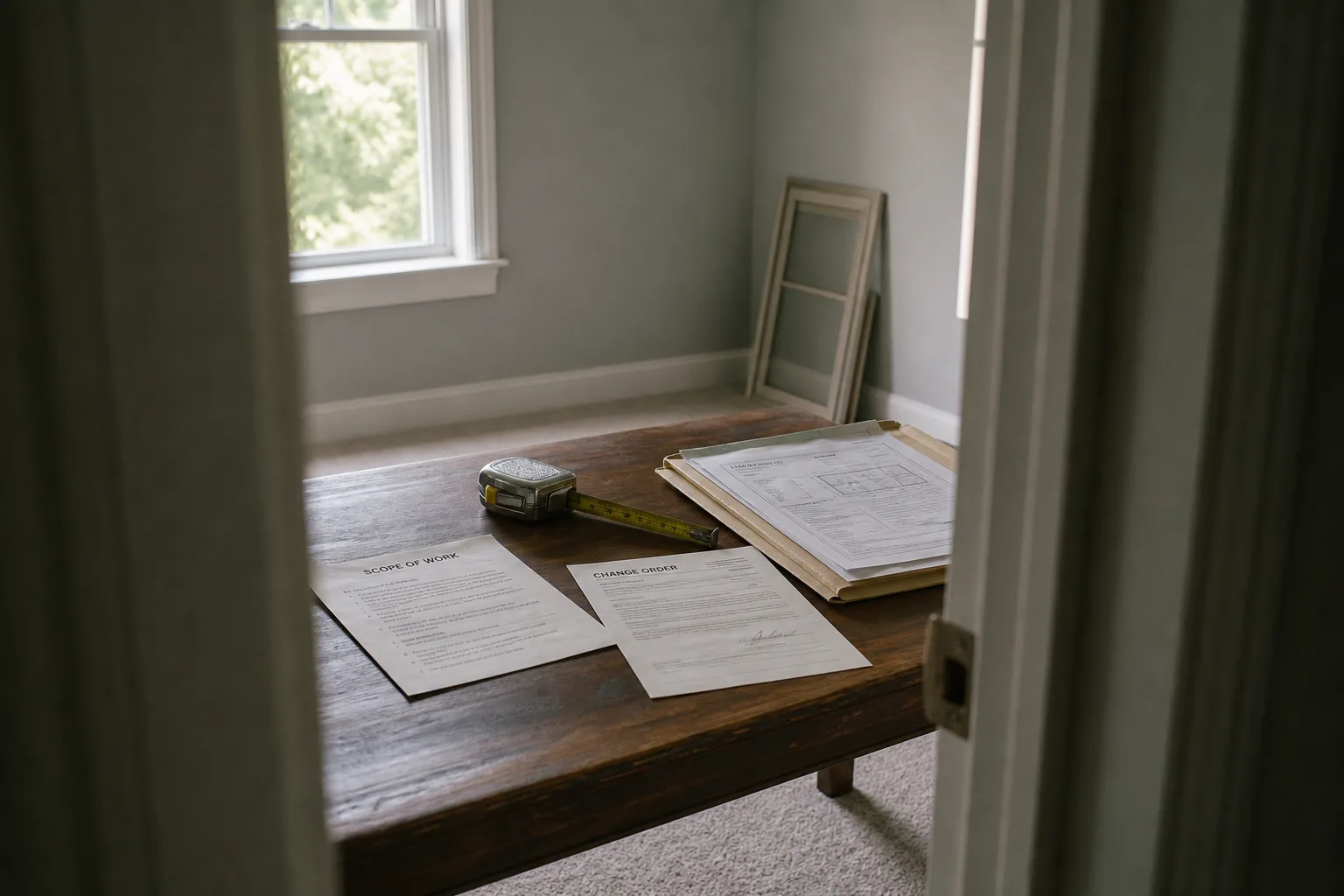
A proposal that reads "convert spare bedroom to home office" followed by a single number is enforceable, collectible, and almost useless three years later, when the question is which part of that number was a repair you could deduct in the year you paid it and which part was an improvement you have to capitalize and recover slowly. The scope of work is the last document written before anyone has a reason to remember the job differently. Whatever it says gets copied forward, largely unexamined, into the depreciation schedule, the basis file, and eventually the closing statement.
One room, two categories of spending, one invoice
Take a narrow case and hold it still: a sole proprietor turning a 140 square foot spare bedroom into a dedicated office, exclusively and regularly used for business, in a house she owns. The crew will patch a ceiling stain from a roof leak that was fixed last spring, run a dedicated circuit from the panel, build in a desk and shelving, replace the window, and paint. That is one crew, one week, one invoice. It is also, in tax terms, at least two categories of spending and possibly three, and nothing about the physical work signals where the boundary falls.
Patching and painting the ceiling restores something to its prior condition, which reads as a repair. The dedicated circuit and the new window enlarge the property's capacity or extend its life, which reads as a capital improvement, added to basis and recovered through depreciation over the long schedule that applies to residential real property. The built-in cabinetry may be a separate asset with its own life. The IRS administers these distinctions and audits them, and it does so from the paperwork, not from a walk-through of a room that by then may have been painted twice.
Three ways the same job gets written, and what each one costs later
The first version is the lump sum: a paragraph of description, a single price, a payment schedule tied to dates. It is fast, it is what most homeowners are handed, and it is fine for a job with no tax consequence at all. Applied to this room, it forces an allocation after the fact, done by the taxpayer or her preparer with no contemporaneous support, in a year when the contractor has moved on and will not be answering emails. The allocation may be defensible. It is not documented, and documented is the standard that matters.
The second version is the line-item scope: the same job, priced by task, with labor and materials separated on each line. Demolition and patching sits on one line, the electrical rough-in and panel work on another, the window unit and its installation on a third, the cabinetry on a fourth, finish painting on a fifth. Now the invoice sorts itself. The repair lines go to current-year expense against the business-use portion, the improvement lines go to basis, and the arithmetic is the contractor's arithmetic rather than a reconstruction made under pressure years afterward.
The third version is two agreements with the same contractor, executed the same day: one for the repair work, one for the improvement work, each with its own scope, price, and invoice. This is more paperwork than most jobs of this size warrant, and it is genuinely worth it in one situation, which is when the improvement portion is large enough to matter on a future sale and the property has a mixed use history. Two contracts produce two paper trails that never have to be untangled, because they were never tangled.
Between the second and third options, the line-item scope wins on effort and loses nothing on substance in most cases, provided the lines are written by category rather than by day. A contractor who prices by phase, meaning week one and week two, has given you a schedule, not an allocation. Ask for pricing by scope element instead, and ask before the proposal is finalized, because a contractor will restructure a bid he has not yet signed far more willingly than one he has.
The steps that close behind you
Three things happen in a fixed order on this job, and two of them cannot be reopened. The W-9 comes first. A sole proprietor paying a contractor for work on business property is making a payment in the course of a trade or business, which carries an information reporting obligation for unincorporated payees above the annual threshold, and the leverage to collect a taxpayer identification number exists only while money is still owed. Request it with the signed scope, before the deposit clears. Afterward you are asking a paid contractor for a favor, in January, by email.
The permit application comes second, and the name on it, along with the described work, becomes a public record that outlives everyone's memory. If the scope says "repair" and the permit says "finish basement and add circuit," you have two official descriptions of the same job that do not agree, and the one you did not write is the one an assessor or a buyer's inspector will find. Read the permit application before it is filed. Contractors fill these out quickly and generically, and a two-word correction at the counter costs nothing.
The business-use percentage comes third, and it is the one number the contractor has no part in. Measure the room and the house before the walls move, write the figures down with the date, and keep the sketch. Square footage measured after the built-ins are installed is a different number than square footage measured before, and the difference is small enough to look like carelessness and large enough to shift a deduction. That measurement is cheap on a Tuesday afternoon in an empty room and impossible to reconstruct honestly later.
What the folder has to hold, and for how long
The current-year repair deduction needs the invoice, the proof of payment, and the scope that shows the line was restorative. Three years past the filing date covers the ordinary case, and seven is the cautious answer for a business return. The improvement lines are different, and this is where people throw away the wrong paper. Anything added to the basis of the house has to be provable until the house is sold, the gain is computed, and the statute on that year's return has run out. For a house held two decades, that is a twenty-five year file.
Depreciation taken on a home office comes back at sale as recapture, whether or not it was actually claimed, which makes the improvement records worth keeping for the deduction side and the exposure side both. Scan the signed scope, the change orders, the final invoice, the lien waiver, the permit and its final inspection sign-off, and the dated room measurement, and keep them in one place with the closing documents from the original purchase. Storage is free. Reconstruction, when a buyer's attorney or an examiner asks, is not.
Change orders deserve the same treatment as the original scope and rarely get it. Mid-job additions arrive verbally, get confirmed by text, and land on the final invoice as a single adjustment with no category attached. Ask for each change order to state whether it modifies a repair line or an improvement line, in the same language the original scope used, and the invoice stays sortable to the end. That request costs a sentence in the contract, placed near the change order clause, and it is the cheapest paragraph in the whole agreement.
The room gets finished either way. What differs is whether the file it produces answers questions on its own, or whether it needs you standing next to it, remembering, at a point when remembering is worth nothing.