Estate Sale Gold Priced Near Melt? What to Check Before the Cash Leaves Your Hand
A single narrow case, a heavy gold bracelet on a folding table with a handwritten tag, and the order in which the checks have to happen before you pay.
Hector Villanueva997 words
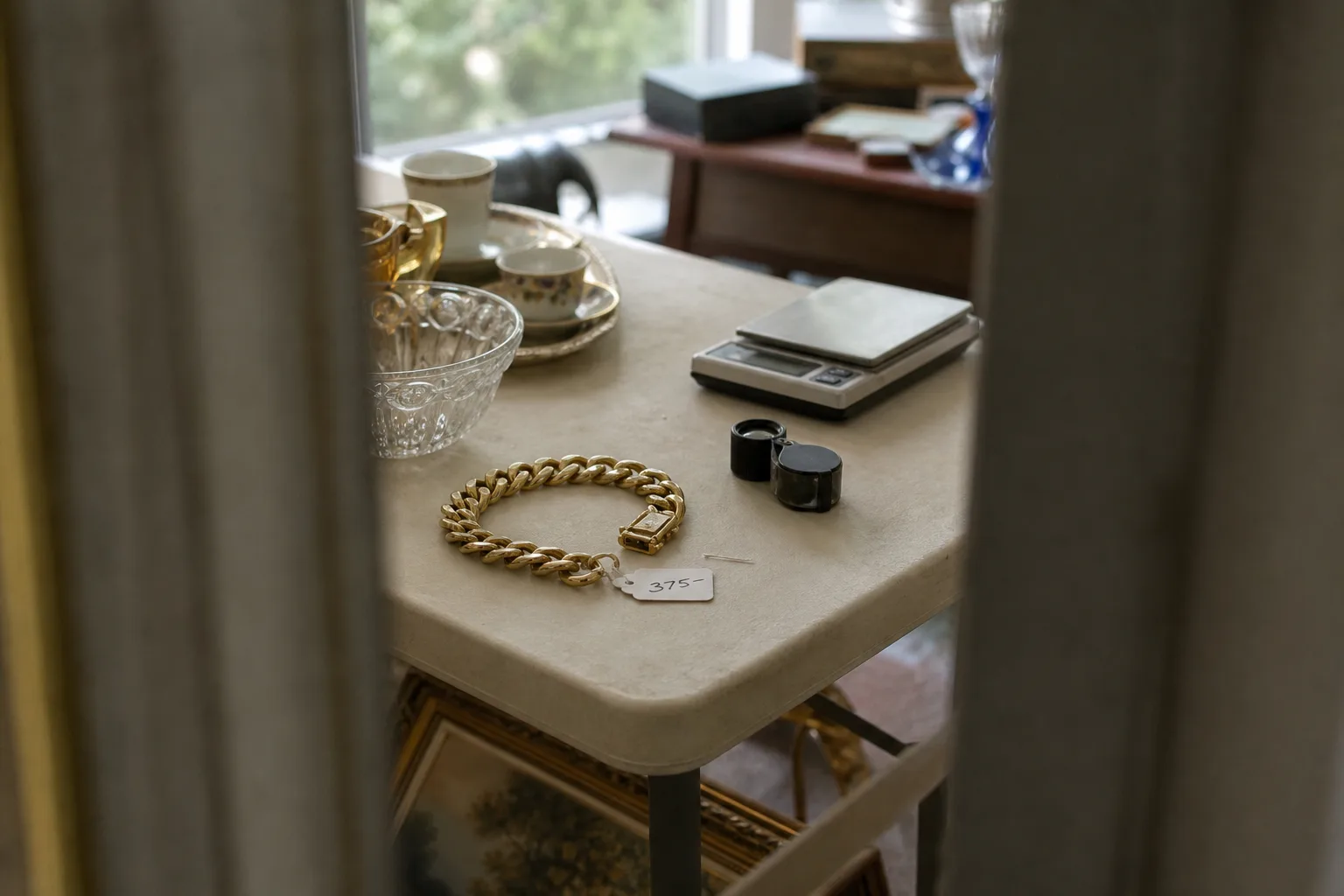
The case I keep coming back to is small and ordinary: a heavy link bracelet on a folding table at a Saturday estate sale, marked 14K somewhere near the clasp, tagged at a price that looks like somebody did the melt math and added a little. Everything about the decision is decided in about eleven minutes, standing up, with two other people waiting behind you. That compression is the whole problem. The judgement you need is not connoisseurship, which takes years, but a short sequence of checks run in a fixed order, because one of the steps closes the others off once you pass it.
The metal price is the floor, and it is the only number you can verify on the spot
Start with what is checkable. Gold trades publicly, karat is a stated fraction of pure metal, and a jeweler's scale costs less than a tank of gas. Fourteen karat is a bit over half gold by weight, so the melt value of a bracelet is its weight times that fraction times the spot price, and you can do that arithmetic on a phone while you hold the thing. What you cannot do on the spot is confirm the karat stamp is honest, because stamps get added, and plated pieces get stamped by people who knew exactly what they were doing.
So the floor is provisional. Treat the melt figure as the number that tells you whether the asking price is even in the right conversation, not as a guarantee of recovery. A magnet is a crude screen and a poor one, since gold is not magnetic but neither is a lot of plating base. A dealer's acid or electronic tester settles it in a minute, which is why the second question in this whole sequence is about testing, not about price. The arithmetic gives you a boundary. It does not give you the answer.
The marks decide the rest, and reading them takes the five minutes nobody offers you
Melt is the worst outcome for a piece that has any other identity, and identity lives in the marks. A karat stamp tells you about the alloy. A maker's mark, a registered trademark, a country of origin stamp, a serial number inside a clasp: those tell you whether the bracelet is a commodity or a named object, and the gap between those two states is not incremental. It is the difference between selling something by the gram and selling it by the name. Bring a loupe. A cheap ten-power loupe fits in a coat pocket and does more work than any other tool you can carry.
What you do with an unfamiliar mark is photograph it, close and in focus, against the clasp, and then leave. Marks are researchable in an evening. They are not researchable while a stranger taps the table. If the mark resolves into a house you recognize, you go back Sunday and pay the tagged price gladly. If it resolves into nothing, you have lost a Saturday and no money. That asymmetry is the entire argument for slowing down, and it holds at every price point I have watched it tested.
Four questions to ask the person holding the tag, in this order
First: has this been tested, and by whom. An estate liquidator who sent the jewelry out for testing will say so immediately and usually has a sheet. Second: is there any return window, even an hour, even until the sale closes Sunday. Third: what came with it, meaning boxes, papers, an appraisal from twenty years ago, an insurance rider naming the piece. Fourth: has it been repaired, because a resized shank or a replaced clasp in the wrong alloy changes both the melt math and the value to a collector. Ask them plainly. Estate staff answer plain questions.
The reason for the order is that the answers cascade. A tested piece with a return window makes the marks question less urgent, because you can research after payment and unwind the trade. An untested piece sold final, cash only, no returns, means every remaining check has to happen before your hand leaves your wallet. The Federal Trade Commission is responsible for how precious metal and gemstone content is described in commerce, and its jewelry guides are the reason a professional seller states karat carefully. A card table at a house sale is a different environment, and you supply the rigor yourself.
What the payback actually looks like when you go to sell
I track this the way I track a utility bill, which is to say I want to know what the thing returns, not what it is worth in the abstract. A refiner pays a discount to spot, because refining costs money and the margin is the business. A pawn counter pays less than that. A consignment through an auction house pays closer to retail on a named piece but takes a commission from the hammer price, charges a buyer's premium that suppresses bidding, and settles weeks after the sale. None of that is hidden. All of it has to be priced in on the Saturday, before you buy, not discovered later.
Which means the bracelet only works as a purchase in two shapes. Either you buy well under a verified melt figure, so the refiner's discount still leaves you whole, or you buy a named piece whose mark you confirmed and whose resale route you already know. The middle case, a decent unsigned bracelet at roughly melt, is a wash at best and a slow loss once the spread is counted. Recognizing that middle case on sight is the judgement worth building, and it is built from about six of these Saturdays.
Photograph the mark, ask the four questions, do the arithmetic in the driveway, and accept that some pieces will sell before you get back. The ones you lose that way are cheap. The one you buy after checking is the one that holds its number.