Paying Extra for a Word on the Box? Which Claims Are Audited and Which Are Free
Some front-of-package claims cost a manufacturer real money in audits and testing, and some cost nothing at all. Knowing which is which changes what you pay per week.
Hector Villanueva1,036 words
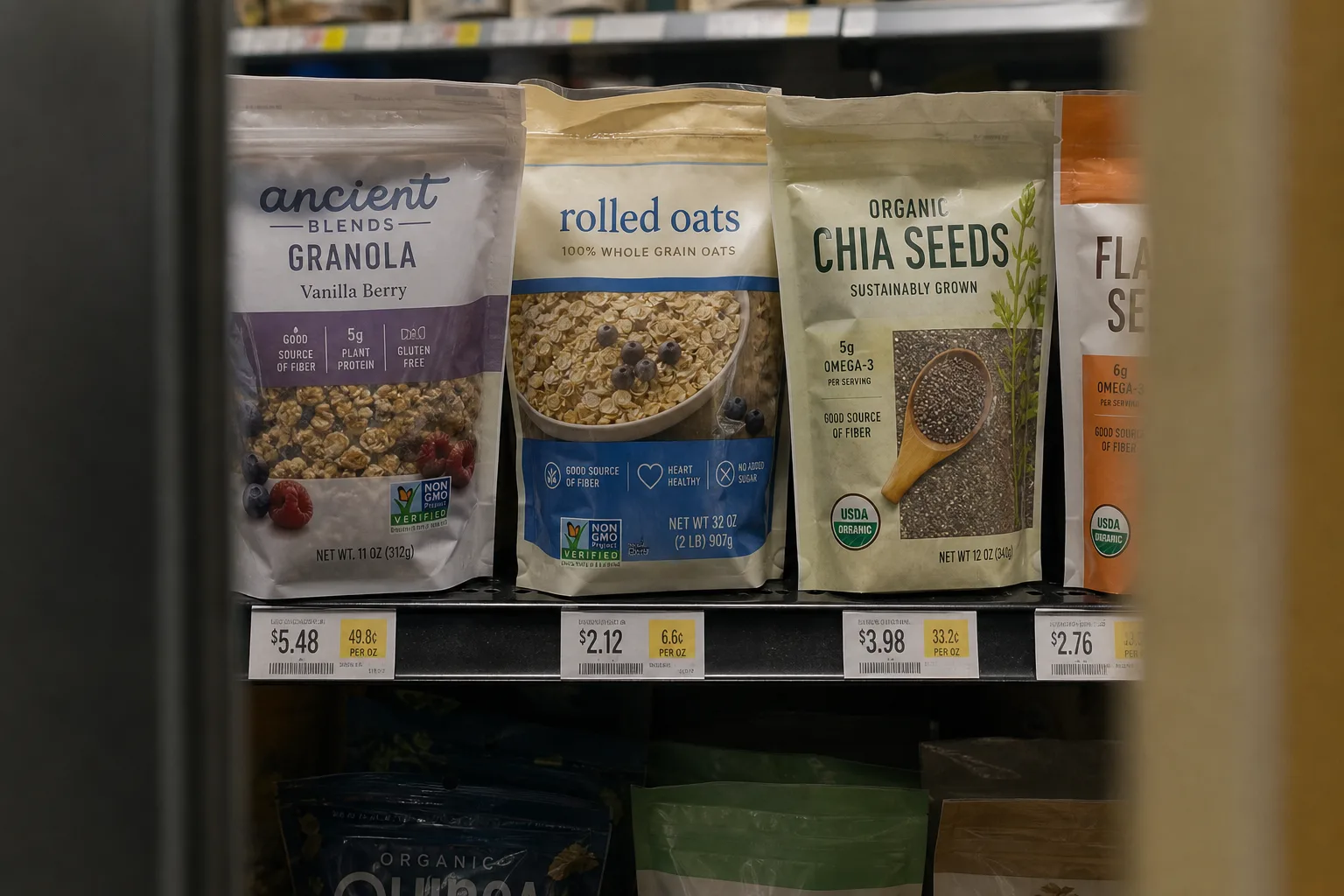
A grocery bill behaves like a utility bill: it is a small number repeated many times, and the repetition is where the money is. A dollar of premium on a package you buy twice a month is roughly twenty-five dollars a year, which is a real line item, and the question worth asking at the shelf is what that dollar bought. Sometimes it bought a third-party audit, a laboratory test, or a documented supply chain. Sometimes it bought a word that any company may print without doing anything, because nobody checks it.
The claims that cost a manufacturer money before they reach the box
Certification has a cost structure, and it is not mysterious. USDA Organic certification involves an application, an on-site inspection by an accredited certifier, annual renewal, and recordkeeping that has to survive an auditor tracing a finished case of product back to the field. Gluten-free carries a testing burden, because the claim is tied to a numeric threshold and a threshold has to be measured. Kosher and Halal certification bring supervision fees and, in some plants, a supervisor's physical presence. These are recurring operating costs, not one-time art department expenses, and they show up in the shelf price because they have nowhere else to go.
Verification also constrains sourcing, which is usually the larger expense. A processor who wants an audited claim on a multi-ingredient product needs every input to carry documentation, so the supplier list narrows and the negotiating position weakens. That is why an audited claim on a single-ingredient item, plain rolled oats, say, tends to carry a modest premium, while the same claim on a product with fourteen ingredients carries a wide one. When you compare two packages, the ingredient count is a decent proxy for how much verification actually cost.
What changed recently, and why the wording on the front is moving
The Food and Drug Administration oversees nutrient content claims on packaged food, and it revised the rule governing when a product may be labeled healthy. The older definition was built around limiting total fat, which pushed foods like salmon, nuts, and avocados outside a word they arguably deserved, while leaving room for products that were low in fat and high in added sugar. The revised approach asks a product to contain a meaningful amount of food from a recognized group and to stay under limits for added sugars, sodium, and saturated fat. Manufacturers have a multi-year runway to comply.
That runway is the part that affects your cart. A company facing a compliance date has two options, reformulate the product so it still qualifies, or drop the claim and replace it with something unregulated that reads similarly. Reformulation costs money: new sourcing, new shelf-life testing, new production runs, and the genuine risk that regular buyers notice and leave. Dropping the word costs a design revision. Over the next few years you will see both happening on the same aisle, which is exactly why the distinction between an audited claim and a free one is becoming more useful, not less.
A second change is moving in parallel. Front-of-package nutrition labeling, a small standardized box summarizing saturated fat, sodium, and added sugars, has been proposed as a requirement rather than a marketing choice. Standardized information is cheap for a shopper to read and expensive for a manufacturer to argue with, because it sits on the front where the claims live and reports the same three things on every package. Where that box exists, the marketing language above it becomes decoration, and the comparison you actually want takes about four seconds.
The claims that are free to print
Natural is the clearest example. It has no binding definition for most foods, it requires no audit, and it costs a company nothing beyond ink. Farm fresh, artisan, wholesome, and crafted belong to the same family. Made with whole grains tells you whole grain is present, not that it dominates, and multigrain tells you only that more than one grain was used, which is true of most sandwich bread. No hormones added on a package of chicken or pork is accurate and meaningless at once, since federal regulations do not permit hormones in those animals in the first place.
Antibiotic language is worth separating carefully, because two similar phrases carry different weight. A claim about how the animal was raised, supported by a documented production protocol reviewed by the Department of Agriculture, means something and costs the producer something. A vaguer statement that the product contains no antibiotics is closer to a restatement of the withdrawal rules every producer already follows. The tell, reliably, is whether the claim points to a program, a certifier, or a standard you could go look up, because verification leaves a paper trail and marketing does not.
Running the check in the aisle, in order
Turn the package over first. The Nutrition Facts panel and the ingredient list are federally standardized, they are the same on every competing product, and they answer most of the questions the front is trying to answer for you. Then look for a certifier's mark rather than an adjective, since a mark implies a body that could withdraw it. Then, and only then, decide whether the premium is worth paying, comparing per ounce or per serving rather than per package, because package sizes drift and the unit price on the shelf tag is doing arithmetic you would otherwise do badly.
Do that once per category rather than once per trip. Most households buy the same forty or so items on rotation, so a single careful pass through the staples, cereal, bread, yogurt, chicken, canned tomatoes, sets the defaults for a year of shopping. The savings arrive the way efficiency savings usually do, quietly and cumulatively, in a bill that stops creeping. And the premiums you keep paying will be the ones attached to something a third party actually checked.
The useful shift here is that the regulated parts of the package are getting stronger and more standardized while the unregulated parts stay exactly as cheap to print as they always were. That widens the gap between the two, and a widening gap is easy to see once you know where to look.