One Cracked Pallet, a Clean Delivery Receipt, and the Paperwork That Decided Who Paid
A small shipper lost a claim to a signature, rebuilt its packing and photo records in a week, and turned damage into a number a buyer could read.
Anneliese Brandt1,226 words
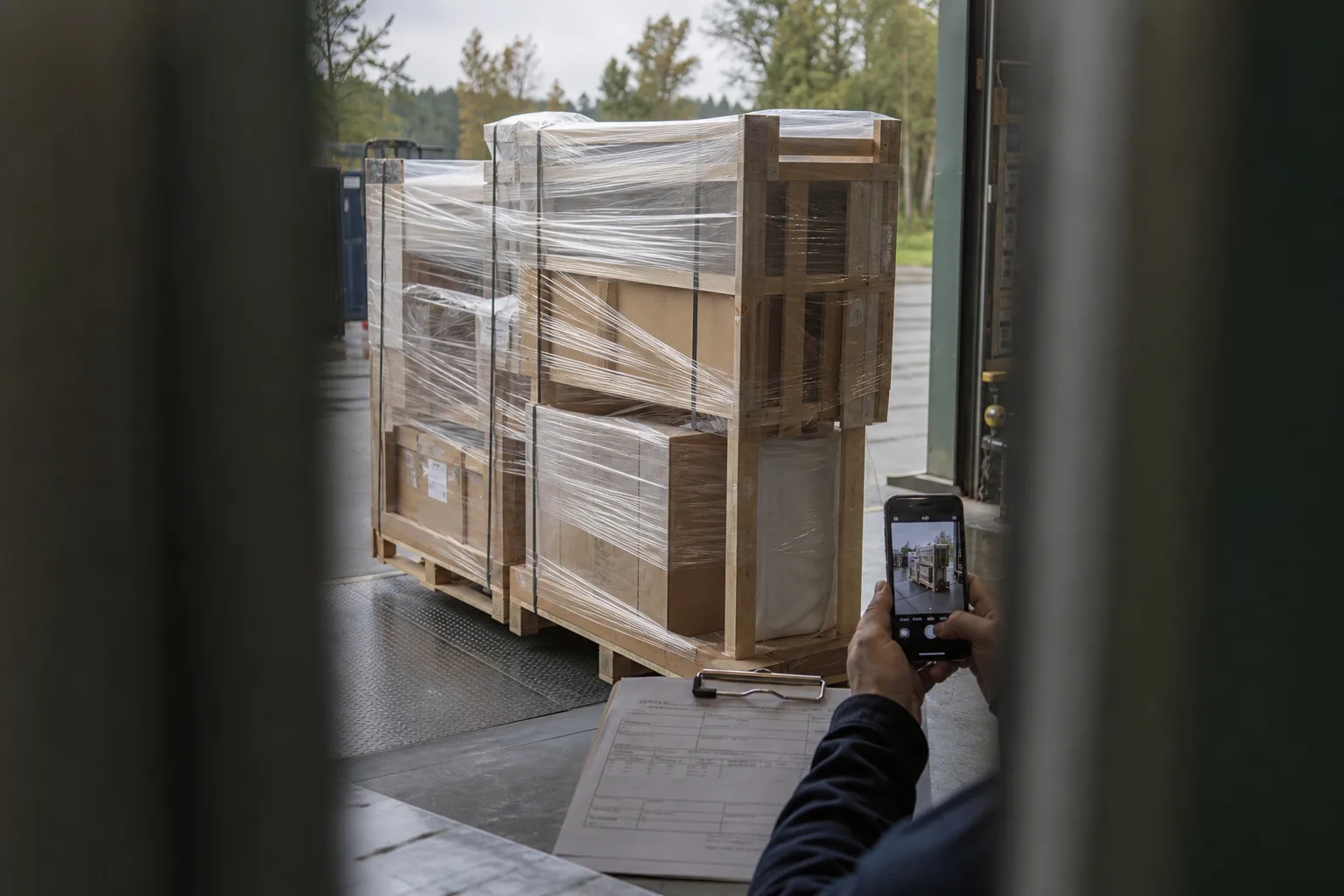
The shipment that started this was not unusual: four refinished cabinets and a crate of glass shades, moving on a pallet from a two-person shop in Ohio to a design showroom outside Atlanta, on a standard less-than-truckload service the shop had used for years. It arrived on a Tuesday. The receiver was busy, the driver was fast, and the delivery receipt was signed without a mark on it. Nine days later the showroom opened the crate and found two shades broken and a cabinet door split at the stile. The claim that followed took four months and paid nothing.
What made it worth studying was not the money, which was under two thousand dollars, but the fact that nobody in the chain gave a straight answer about who carried the loss. The carrier pointed at the packing. The shop pointed at the handling. The showroom pointed at both and paid neither. The documents that would have settled it in a week either did not exist or had been signed away at the dock.
The signature that could not be taken back
Freight liability turns on a small number of moments, and the largest of them happens in about fifteen seconds at a loading dock. A clean delivery receipt is a statement that the goods arrived in apparent good order, and while concealed damage claims exist and are sometimes paid, the burden shifts hard the moment that signature goes down unqualified. Everything the shop did afterward, the photographs, the emails, the repair estimate from a local finisher, was work performed on the wrong side of an irreversible step. The receiver had not been told what to write, because nobody had ever written it down for him.
The correction was procedural and cheap. The shop drafted a half-page receiving instruction and sent it with every shipment confirmation: count the pieces against the bill of lading before signing, walk the shrink wrap, and if anything is crushed, punctured, leaning, or short, write it on the receipt in plain words before the driver leaves. Not a protest, just a note. Subject to inspection, three cartons scuffed, one corner crushed. That sentence is the difference between a claim with a record and a claim that is an argument.
What the three documents actually decide
Interstate motor carriage is a paper system wearing a truck. The bill of lading establishes what moved, how it was described, and what class and declared value applied. The delivery receipt establishes the condition on arrival. The packing record, which most small shippers do not keep at all, establishes whether the goods were tendered in a condition fit for the ordinary rigors of freight handling, which is the carrier's most common and most effective defense. The Federal Motor Carrier Safety Administration oversees interstate motor carriers and the framework they operate under, and the practical shape of that framework is that a shipper who cannot document its own packing has already conceded the argument it needs to win.
The shop had a bill of lading and a signed receipt. It had no packing record. It could describe how the crate was built, because the same person built every crate, but description is not evidence and the carrier's adjuster said so politely, twice. The third document was the missing one, and it was the only one entirely within the shop's control.
The ordinary week after the change
The new routine costs about twelve minutes a shipment and it runs the same way every week. Pack the item, photograph the goods bare, photograph the internal blocking and the void fill before the lid goes on, photograph the closed and labeled package, photograph the pallet built and wrapped with the label visible. Four images, timestamped by the phone, dropped into a folder named for the pro number. Weigh the pallet and write the weight on the bill of lading rather than estimating it, because a weight that does not match the carrier's scale invites a reweigh, a reclass, and a conversation in which the shop is already on the back foot.
Friday afternoon is reconciliation. Every shipment that moved that week gets its delivery receipt pulled from the carrier's portal and filed with the photos, and anything with a notation on it opens a file that day rather than when a customer eventually calls. Twice in the first year that Friday hour caught a noted exception the receiver had never mentioned, and both were settled inside a month because the packing photographs answered the packing question before it was asked. The rhythm matters more than any single piece of it. A claim file that is assembled after the fact looks assembled. A claim file that falls out of the week looks like a record.
Declared value, insurance, and the gap between them
Carrier liability on ordinary freight is not the value of the goods. It is limited by the released value stated in the tariff and on the bill of lading, usually expressed as a dollar figure per pound by commodity class, and for light, fragile, high-value items that limit can be a small fraction of what the shipment is worth. The shop had never read that section. Its cabinets were valuable and not heavy, which is the worst combination under a per-pound limit, and even a fully successful claim would have covered a portion of the invoice.
Two fixes closed the gap. The first was excess declared value bought from the carrier on the shipments that warranted it, priced per hundred dollars of coverage and worth taking on the high-value lanes and skipping on the rest. The second was a shipper's interest policy through the shop's own broker, which pays on the value of the goods rather than on carrier fault, and which turns a four-month liability argument into a claim with a deductible and a date. The carrier claim still gets filed, because the carrier's tariff sets a window measured in months and letting it lapse forfeits a recovery the insurer may want to pursue, but the shop no longer waits on it to make the customer whole.
What a buyer sees in the file
Two years later the shop went to market, and the diligence request that mattered was not the tax return. It was a schedule of shipments, damage incidents, claim outcomes, and net loss by quarter. A business that can produce that schedule is priced on its earnings. A business that cannot is priced on the buyer's assumption about what the damage rate might be, and buyers assume badly, in their own favor, every time. The packing photographs and the Friday hour were bought as a claims tool and sold as something else entirely: proof that a known cost was measured, bounded, and falling.
The improvement a buyer never sees is the crate design itself, the blocking and the corner protection and the second pallet band, because none of that appears in a financial statement. What appears is a damage line that stays flat while volume grows, and a folder for every pro number that a stranger can open and read without being walked through it.
The shipment that was lost was lost at the dock, in fifteen seconds, by a man who was never told what to write. Everything built afterward was built to make sure the next fifteen seconds had a document behind them.