Bidding on an Estate Ring? The Costs That Land After the Hammer, and What to Ask First
A repeat buyer's Art Deco ring cost far more than the hammer price, and the questions that would have priced it correctly all had to be asked before the sale.
Douglas Mackenzie1,115 words
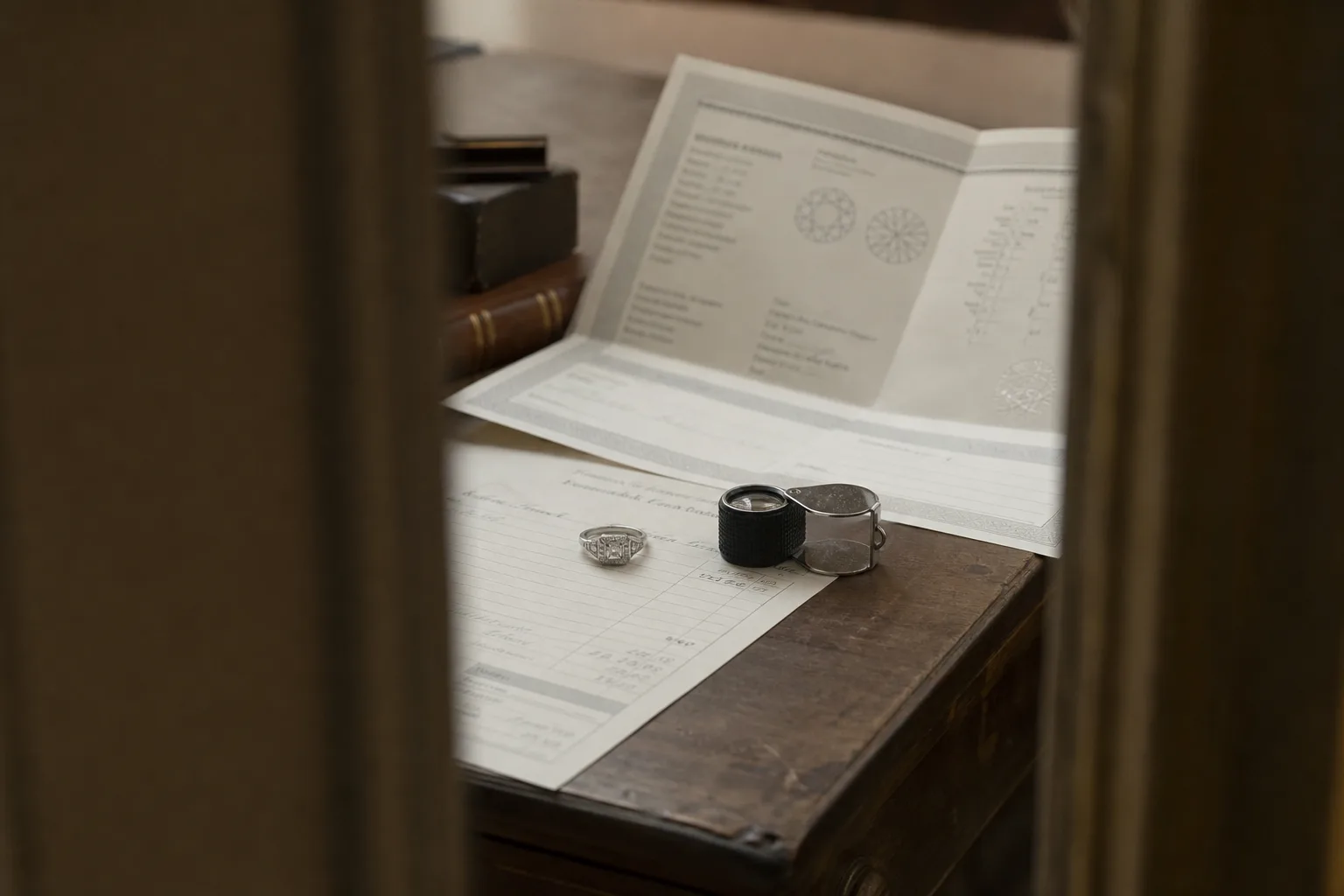
A buyer I have worked with for years, someone who has bought perhaps forty pieces at regional auction and private sale, brought me an Art Deco diamond ring last spring and a folder with six pieces of paper in it. The hammer price was the smallest number in the folder. That is not unusual, and it was not a mistake; she had priced the rest of it before she raised the paddle, which is why the ring was still a good buy. What follows is that transaction taken apart, because the order in which the costs arrive decides which ones you can still refuse.
The hammer price was the first of five invoices
She won the ring on a Thursday. The invoice that arrived that evening carried the hammer price, the buyer's premium calculated as a percentage on top of it, and state sales tax applied to the combined figure rather than to the hammer alone. That last detail catches people who budget from the estimate range in the catalog and forget that tax compounds on the premium. Shipping was quoted separately, fully insured, signature required, because the house would not release a stone of that value to an ordinary parcel service. Five separate line items, one lot, and only the first of them was set by bidding.
Then came the costs she chose. An independent appraisal, priced by the hour rather than as a percentage of value, which matters enormously and is the single easiest way to overpay. A grading report on the center stone, ordered through her jeweler and sent to a laboratory, with a turnaround measured in weeks. Sizing down two and a half sizes on a platinum shank, which is real bench work, not a quick cut and solder. A scheduled rider added to her homeowners policy, priced annually against the appraised figure. By the time the ring went on her hand it had cost noticeably more than the number she had shouted, and she had known that ratio going in.
What actually drives the cost, and it is rarely the carat weight
Buyers new to estate jewelry fixate on size. She does not. On a period piece the variables that move the price hardest are whether the center stone is original to the mounting, whether the mounting has been retipped or reshanked badly, whether the cut is an old European or a modern round that somebody dropped into an antique head, and whether the piece is signed. A signed Deco platinum ring with an original old European center and untouched millegrain trades in a different bracket from a lookalike assembled last decade from period parts. The catalog will often describe both in nearly identical language.
Condition drives the second half of the number, and it drives it after you own the piece. Worn prongs, a thin shank, cracked enamel, a replaced clasp on a bracelet, solder repairs visible under magnification: each one is bench time, and platinum bench time is not cheap because the metal works hot and slow. She budgets restoration as a percentage of the hammer price on anything over about eighty years old, and she assumes the number rather than hoping for zero. On this ring the sizing came in near her estimate. On the piece before it, a Victorian brooch, the pin stem and catch both had to be replaced and the work cost more than the brooch.
The questions that have to be asked before the paddle goes up
Everything worth asking has to be asked while you can still walk away, because most auction sales are final and the condition report is the only warranty you will get. She asks the same six things every time. Is there a laboratory report, from which lab, and how old is it. Is the center stone original to the mounting, and if the house will not say, will they let a jeweler examine it in person or on video before the sale closes. Has the piece been repaired, and where. Is the metal tested or assumed. What is the total buyer's premium at her expected bid, including any online platform surcharge. And whether sales tax will be charged, or whether her resale certificate applies.
That last question is the one most private buyers skip and the one that most often changes the arithmetic. Tax treatment depends on the state, the venue, and whether the buyer is acquiring for personal use or for resale, and the answer has to be settled before the invoice is generated rather than argued afterward. She also asks who holds the piece if she wants an independent examination between the hammer and the payment, since a house that will place a lot in escrow with a named jeweler is telling you something useful about the lot. Houses that answer all six plainly get her bids. The ones that deflect do not.
The folder is the asset, not just the ring
This is the part I care about, and it is the part almost everyone gets wrong years later when it matters. The Internal Revenue Service is responsible for how gains on collectibles are taxed and for what a taxpayer must be able to produce to substantiate what a thing cost, and jewelry sits squarely in that category, taxed on disposal at a maximum long-term rate above the one that applies to ordinary appreciated securities. Your basis is the purchase price plus the buyer's premium plus the sales tax plus the shipping, and it can be increased by capital improvements such as a replacement stone, though not by routine cleaning or insurance premiums. All of that lives on invoices that people throw away.
So the folder holds the auction invoice showing every line, the shipping receipt, the bench invoice describing exactly what work was done and to which component, the laboratory report, the independent appraisal with the appraiser's credentials and method stated, and dated photographs. Scanned and stored in two places. If the ring is ever sold, that folder is the difference between a computed gain and a gain the agency computes for you from a zero basis. If it is ever donated, an appraisal has to meet specific standards and be timed correctly relative to the gift. If it is ever stolen, the same folder is what the insurance adjuster works from.
She has since bought two more pieces from the same house, both times with the tax question settled before the sale and the bench estimate in hand. The ring appraised comfortably above everything she put into it, which is pleasant but incidental. What made it a clean purchase was that nothing arrived after the fact that she had not already priced.