Winter Dry, Summer Slow. What the Season Changes About Signing Off a Drying Job
A drying crew wants to pull equipment on day three. Whether that is right depends on the month, the materials, and a buyer who will meter that wall years from now.
Anneliese Brandt1,228 words
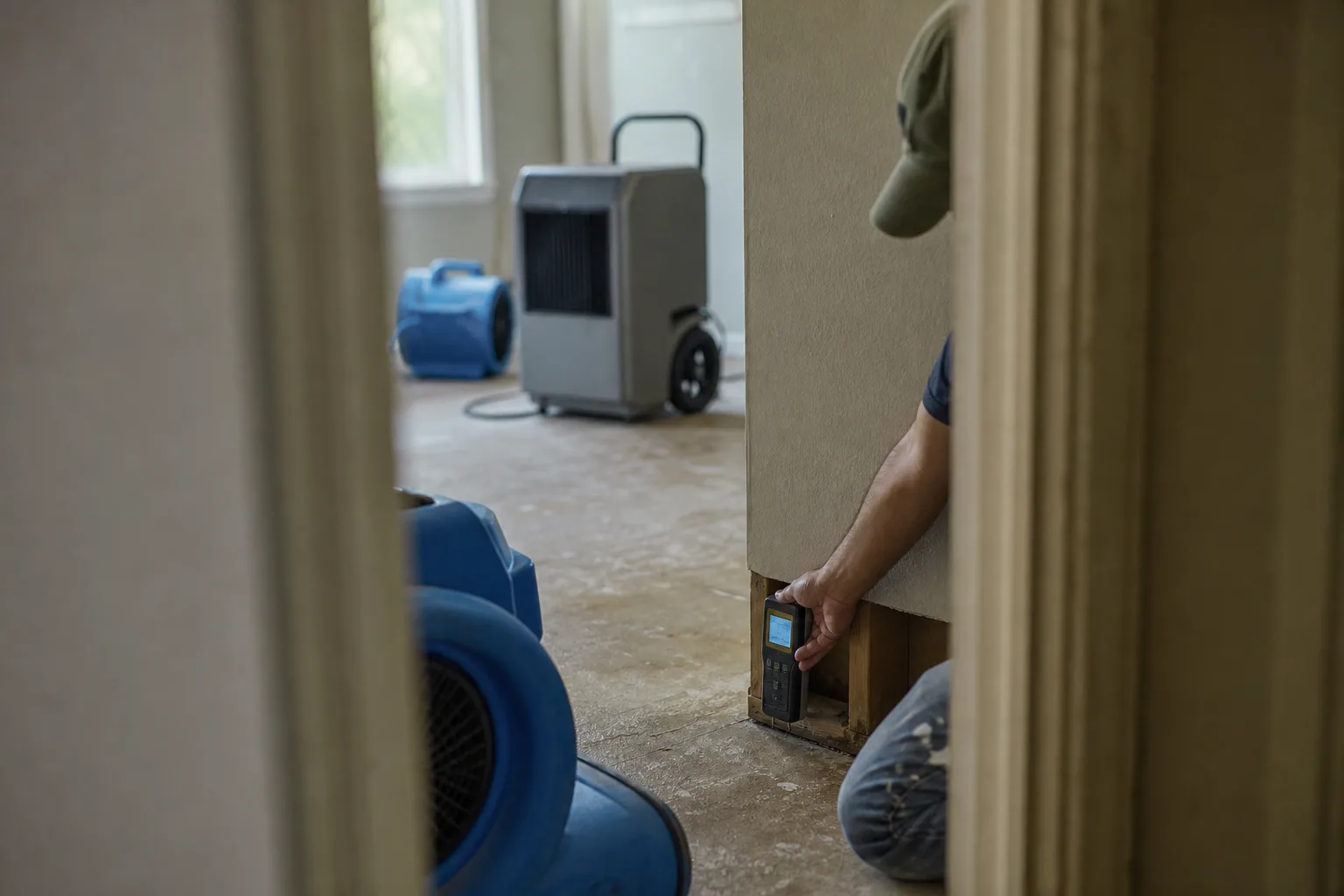
A restoration crew will usually ask to pull equipment on the third or fourth morning, and the question put to you is framed as a courtesy: are you comfortable if we demobilize today. You are being asked to approve something you have no instrument to check, on a schedule set partly by physics and partly by where the next job is. The honest answer depends on the month. Drying a kitchen in January and drying the same kitchen in July are different problems with different failure modes, and the reading that looks finished in one season is a holding pattern in the other.
Dry is a number someone else in the house already established
Professional drying does not aim at the absence of visible water. It aims at a dry standard, which is a moisture content taken from the same material in a part of the house that never got wet: the drywall in the hallway, the subfloor two rooms over, the bottom plate on an interior partition. That unaffected reading becomes the target, and the affected material is dried back toward it rather than toward some universal figure. The practical consequence is that the standard moves with the season, because the whole house is drier in February than in August, and a crew that carries last summer's number into winter is working to the wrong finish line.
Ask for those numbers in writing on day one, not day four. The initial moisture map, the dry standard, and the daily readings by location are the only record that the job was finished rather than abandoned, and they cost nothing to request while equipment is still running. A crew that meters properly produces this as a matter of routine. The document matters later for reasons that have nothing to do with the current claim, which is a point most owners reach two or three years too late to do anything about.
Heating season gives you thirsty air and cold cavities
Winter air brought indoors and heated has very little capacity used up, which is why houses get static and dry lips in January. That works in your favor: evaporation into heated indoor air is efficient, and in a cold, dry climate a crew can sometimes dry a straightforward loss faster than the calendar suggests. The catch sits inside the wall. Cavity surfaces against the exterior sheathing are cold, sometimes below the dew point of the warm, moisture-loaded air you have just pushed into them, and vapor that leaves the wet plate can recondense a few inches away on the cold side of the cavity rather than leaving the assembly.
This is why the winter version of a rushed job hides itself so well. The visible surfaces read dry, the room feels dry, and the moisture has simply relocated to a place nobody meters. Controlled heat on the affected assembly, negative pressure through drilled holes, and dehumidification that captures the vapor instead of letting it wander are what separate a real winter dry-down from a fast one. The tell is whether the crew is measuring inside the cavity or only on the face of the drywall, and you are allowed to ask which they have been doing.
Summer takes away your easiest tool
The instinct in July is to open the windows and put a fan in the doorway. Outdoor air at eighty degrees and seventy percent relative humidity carries a great deal of water, and running it across a wet subfloor adds moisture to the building faster than the fan removes it. Summer drying has to be closed and dehumidification-led: the space sealed, the dehumidifier sized to the volume, and the air conditioning left running rather than shut off to save money while the house is unoccupied. Evaporation is fast in the heat, which is the part people notice, and removal is slow, which is the part that decides the outcome.
The shoulder seasons are the ones that fool experienced people. An October week with warm afternoons and cold nights swings the dew point enough that a wall drying nicely at two in the afternoon is taking moisture back at five in the morning, and daily readings taken at the same hour each day will not show it. This is where a fourth and fifth day of equipment earn their rental. The Environmental Protection Agency is responsible for federal guidance on indoor moisture and mold, and the underlying principle in all of it is the same: dry the material, not the air in the room, and confirm the material rather than assume it.
The person nobody at the job site is thinking about
Everyone standing in the room has a short horizon. The adjuster is managing a claim file, the crew is managing a schedule, and you are managing the disruption. The party with the longest horizon is not there: the buyer who will walk this house in three years, and more precisely the inspector that buyer hires, who will arrive with a pinless moisture meter and run it along the base of every wall in the room that smells faintly different from the rest of the house. That inspector has no interest in your claim history. He reports what the instrument says on the day.
What a shortened dry-down leaves behind is rarely dramatic. It is a cupped section of hardwood that never flattened, a baseboard that reads elevated while the wall beside it reads normal, a faint tide line telegraphing through fresh paint after the second winter, a cabinet toe kick that delaminated quietly. None of it stops a sale. All of it moves money, because a buyer who finds moisture near a known loss stops negotiating about the finding and starts negotiating about everything they now assume you also rushed. The repair you skipped for four hundred dollars of equipment rental gets repriced as an unknown, and unknowns are always expensive at the closing table.
The defense is the paperwork you asked for on day one. A drying log showing affected materials returned to the dry standard, a certificate of completion, and the invoice for the repairs that followed turn a disclosed water event from a red flag into a documented, closed item. Buyers price documented events calmly. Sellers who can produce the readings hand over a file; sellers who cannot hand over a credit.
Building the judgement before you need it
You do not need to read a psychrometric chart to make this call well. You need three things: the dry standard written down at the start, daily readings at the same locations, and a plain answer to why today's numbers justify stopping. If the crew can give you all three without hesitating, the season has been accounted for. If the answer is that the room feels dry, or that the equipment is needed elsewhere, one more day of rental is the cheapest insurance in the entire loss, and you are the only person in the transaction with a reason to buy it.
Set the expectation at the first walkthrough, before anyone is invested in a departure date. Tell the crew you want the moisture map, that you expect readings by location rather than by room, and that you will sign off on the numbers rather than the calendar. That framing costs nothing and it changes how the job is run from the first hour.