Resizing an Inherited Ring Four Sizes Up? Five Checks Before You Hand It Over
A platinum solitaire that fits nobody in the family: what the resize and shank work actually cost, what the cost is made of, and which receipts matter years later.
Douglas Mackenzie831 words
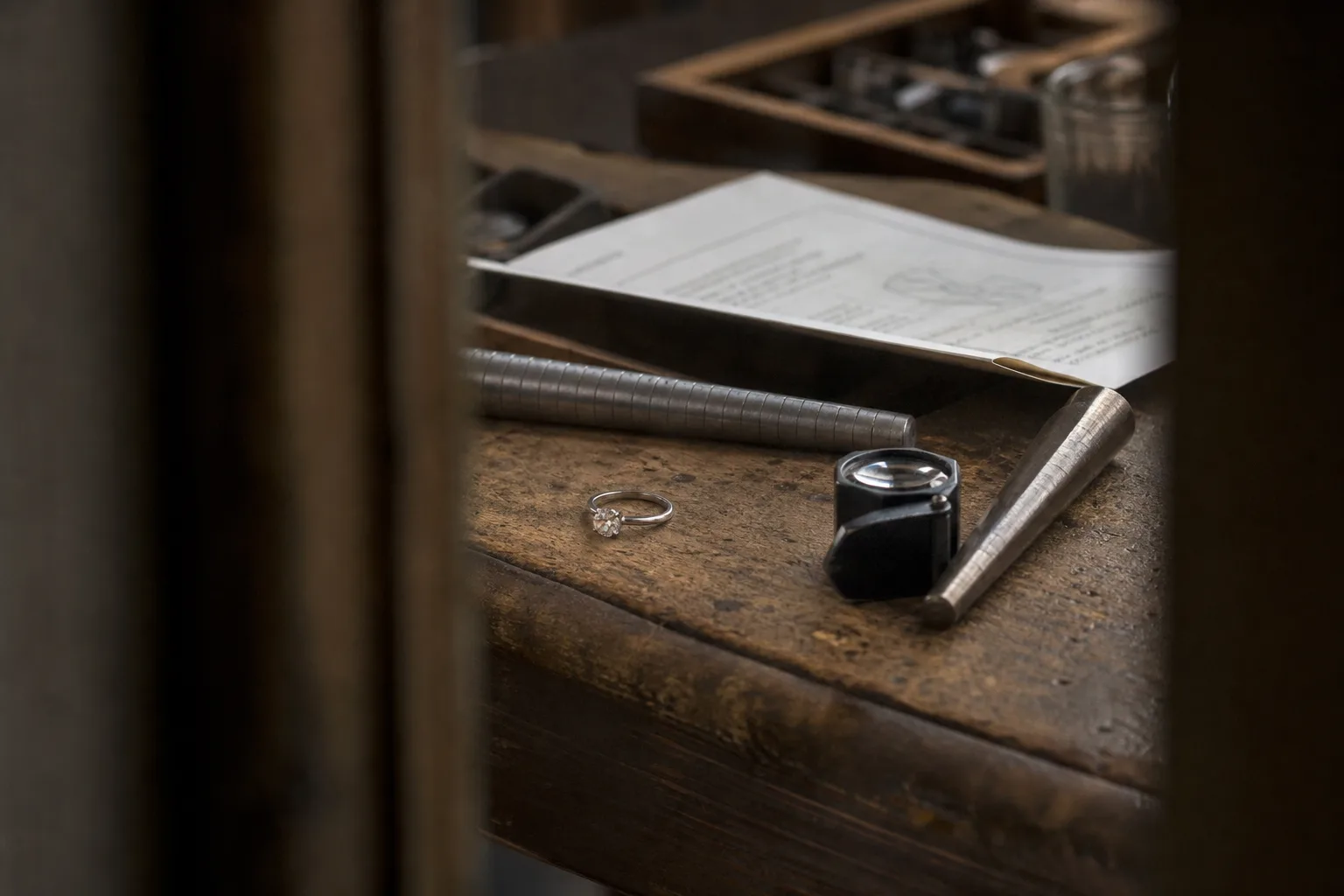
Take a specific object: a platinum solitaire that came out of a safe deposit box after a death, sized 4.5, and the person who now owns it wears a 7. The center stone is fine. The shank has worn thin at the bottom, the way a ring worn daily for forty years does, and one prong sits lower than its three neighbors. Everything about that job is ordinary. What is not ordinary is how much the price moves depending on decisions made in the first ten minutes at the counter, before anyone touches it.
1. Sizing up four sizes is a different job from sizing up one
A one-size increase is usually a cut, a stretch or a small insert, and a polish. Four sizes means adding a real length of metal, matching the alloy, and rebuilding the profile so the added section does not read as a patch. Platinum raises the labor further, because it works at higher temperatures and demands a different bench setup than gold. Ask whether the shop is stretching or adding metal, because stretching thins a shank that is already thin, and on this ring that would be the wrong answer twice over.
2. The worn shank and the prong are one job, not two
The ring is already coming apart at the bench and going back together. That is the moment a half-shank replacement costs the least it will ever cost, because the setup, the sizing and the final polish are shared across both repairs. Deferring the prong to next year means paying the setup a second time and risking a stone loss in between. Sequence matters more than the individual line items here: retipping four prongs during a resize is incremental, while retipping four prongs as a standalone visit carries the whole minimum charge on its own.
3. What drives the number on the estimate
Four things, in rough order of weight. Metal type and how much of it is being added, since platinum is priced and worked differently from 14k. Whether stones have to come out, because a channel of small diamonds around the band turns a simple sizing into a setting job with reset time and risk. Bench hours, which is where a shop's rate and its backlog show up. And finally the finish, since a full refinish on a piece with hand engraving is slower than a polish on a plain band. Ask for those four broken out.
4. The damage that is usually not worth fixing
A chipped diamond can be recut, and the recut is often technically successful and financially pointless, because you pay bench and cutting fees to end up with a smaller stone and a new certificate that says so. Worn hand engraving is similar: recutting it by hand is skilled work priced accordingly, and machine recutting looks like what it is. Deep scratching on a platinum shank that is otherwise sound is cosmetic, and each polish removes metal. The strong candidates for repair are the failures that cause loss: thin shanks, worn prongs, and a loose bezel.
5. The paperwork that has to survive the repair
Here is where most people leave money behind. Personal jewelry repair is not deductible on a Form 1040, and neither is the resize, so nothing about this invoice reduces this year's tax. It still matters. Inherited property generally takes a basis stepped up to value at the date of death, and the appraisal establishing that figure is the single document you cannot recreate later. Keep it with the death certificate copy, the repair invoice, and any updated appraisal, in one place, because the IRS is responsible for the rules on basis and substantiation and those rules run on records, not recollection.
Three specific situations make those records earn their keep. If the ring is ever sold, the gain is measured against that stepped-up basis, and collectibles are taxed at their own rate, so a missing appraisal can turn a modest gain into a large one on paper. If it is ever donated above the qualified appraisal threshold, the deduction rides on an appraisal and a completed Form 8283. If it is ever lost, the insurer wants a current valuation, and a resize plus shank replacement is exactly the kind of change that makes an old appraisal stale. Get it revalued after the bench work, not before.
Casualty loss is the one people ask about most and qualify for least. For personal-use property, the deduction is broadly limited to losses attributable to a federally declared disaster, which a ring going down a drain is not. Insurance is the mechanism there, and the scheduled personal property endorsement is what makes it work.
Photograph the ring on the counter before you leave it, get the estimate itemized by metal, stone handling, bench time and finish, and put the new appraisal in the same folder as the old one rather than replacing it. The folder is cheap. Reconstructing it in eleven years is not.