Fingers Swell in Summer and Shrink in Winter. When to Actually Book the Resizing
Seasonal load on a jeweler's bench changes your wait, your price and who touches the piece. What that means for resizing, repair and what a buyer will never see.
Anneliese Brandt907 words
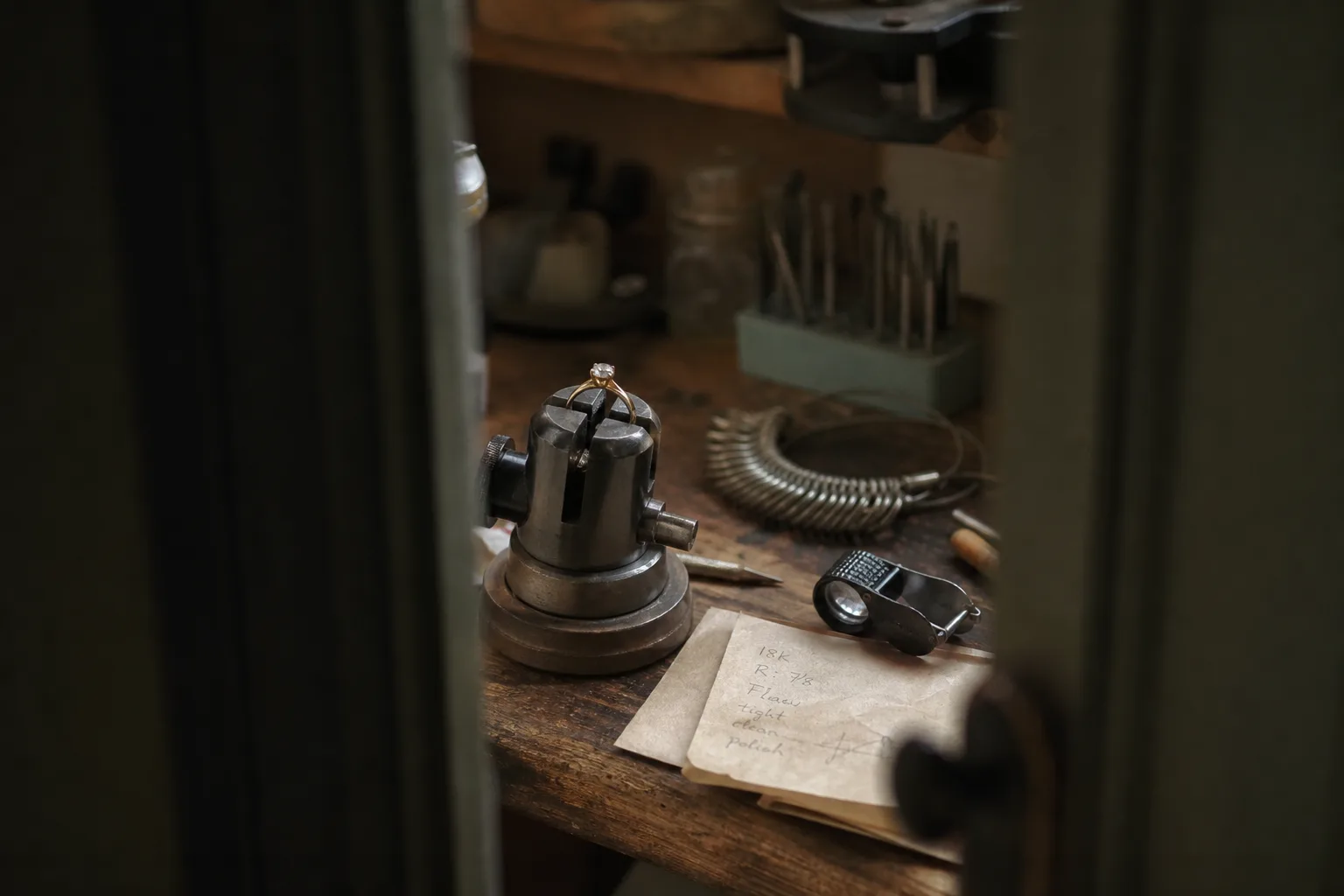
A bench jeweler's year is not evenly loaded, and the difference shows up in your quote, your wait and, less obviously, in who actually holds your ring. Work dropped off in the second week of December competes with every gift-season repair in the county, and work dropped off in the third week of January often sits at the front of an empty queue. Nothing about the metal changes. The scheduling does, and so does the amount of attention a piece gets from the person who is best at the job rather than the person who is free.
That matters more than most households expect, because the decisions inside a resizing or a repair are largely irreversible. Metal that comes off a shank does not go back on in the same condition, a polished surface cannot be unpolished, and a hallmark buffed flat is gone. The order in which you do things, and the season in which you do them, changes the outcome.
The bench is busiest exactly when you notice the problem
Two pressure points dominate the repair calendar. The first runs from late November through the days after Christmas, when gifts need sizing, clasps break at parties, and everyone discovers at once that a chain has been thinning for years. The second runs from January through spring, when engagement rings bought over the holidays go out for sizing and wedding-season work stacks up behind them. Between those, in late winter and again in the deep part of summer, benches are quieter. If your repair can wait six weeks, waiting six weeks buys you a longer, less rushed appointment and often a better price.
The quiet weeks also change who does the work. A busy store sends overflow to a trade shop, which is normal and frequently excellent, but it means the person who quoted you is not the person cutting your shank. In slower months, more work stays in house, and you can talk to the jeweler directly about how a repair will be finished. Ask, plainly, whether the piece leaves the building. The answer is not a red flag either way, but it tells you who to call when something needs revisiting.
Sizing to a hand that is not the same size in July
Finger size moves with heat, salt, altitude and the day's activity, and for many people the swing between a January morning and an August afternoon is close to a full size. Resizing to a summer measurement produces a ring that spins all winter, and resizing to a winter measurement produces one that will not come off in July. The honest fix is to be measured twice, months apart, at a similar time of day, and to size to the middle with a small allowance for the knuckle. If your knuckle is significantly larger than the base of your finger, sizing beads or a hinged shank solve the problem that resizing alone cannot.
There is a resale dimension here that sellers rarely think about. A ring sized down two or more times has a shank that is thinner in section and shorter in history, and a heavily reworked shank is one of the first things a buying jeweler looks at. A single clean sizing is invisible. Three of them, with visible solder lines and an out-of-round profile, reads as a piece that has been worked hard, and the offer reflects it.
The people standing next to your decision
A household repair usually involves more hands than the counter suggests: the bench jeweler who does the sizing, a setter who handles stones, sometimes an engraver, and separately an independent appraiser who has no stake in selling you the work. That last role is the one people skip and later wish they had not. An appraisal and a set of clear photographs taken before the piece leaves your hands establish what was there, which stones were in which positions, and what the finish looked like. The Federal Trade Commission is responsible for how jewelry materials and quality are described in commerce, and its guides are the reason a written description should name metal, weights and stone specifics rather than adjectives.
Insurance sits alongside all of this. A scheduled item on a homeowners policy is usually valued from an appraisal, and a repair that meaningfully changes the piece, a replaced head, a new shank, a substituted stone, is worth reporting so the schedule stays accurate. Do it after the work, with the jeweler's written description in hand.
What is worth fixing, and what a buyer never sees
Structural repairs almost always pay. Retipping worn prongs, replacing a thin shank, rebuilding a clasp and tightening a stone all protect against a loss that costs many times the repair. Cosmetic work is where the math turns. Rhodium plating on white gold is maintenance, not improvement, and a buyer prices it as due. A full polish on an antique piece can quietly remove the crisp edges, the maker's mark and the hand-engraving that carried most of the value, and that subtraction is permanent. Laser welding near a heat-sensitive stone belongs to a jeweler who works on such stones weekly.
Book the structural work in a slow month, keep the original components if any are removed, and get the description in writing before the piece goes back in the drawer. The repair a buyer never sees is the one done properly, without haste, by someone whose name you know.