Breached Mid-Closing? The Freeze That Protects You Can Also Stall Your Loan
A first-time buyer got a breach letter eleven days into a thirty-day escrow, froze her credit, and learned what order the protective steps have to happen in.
Anneliese Brandt848 words
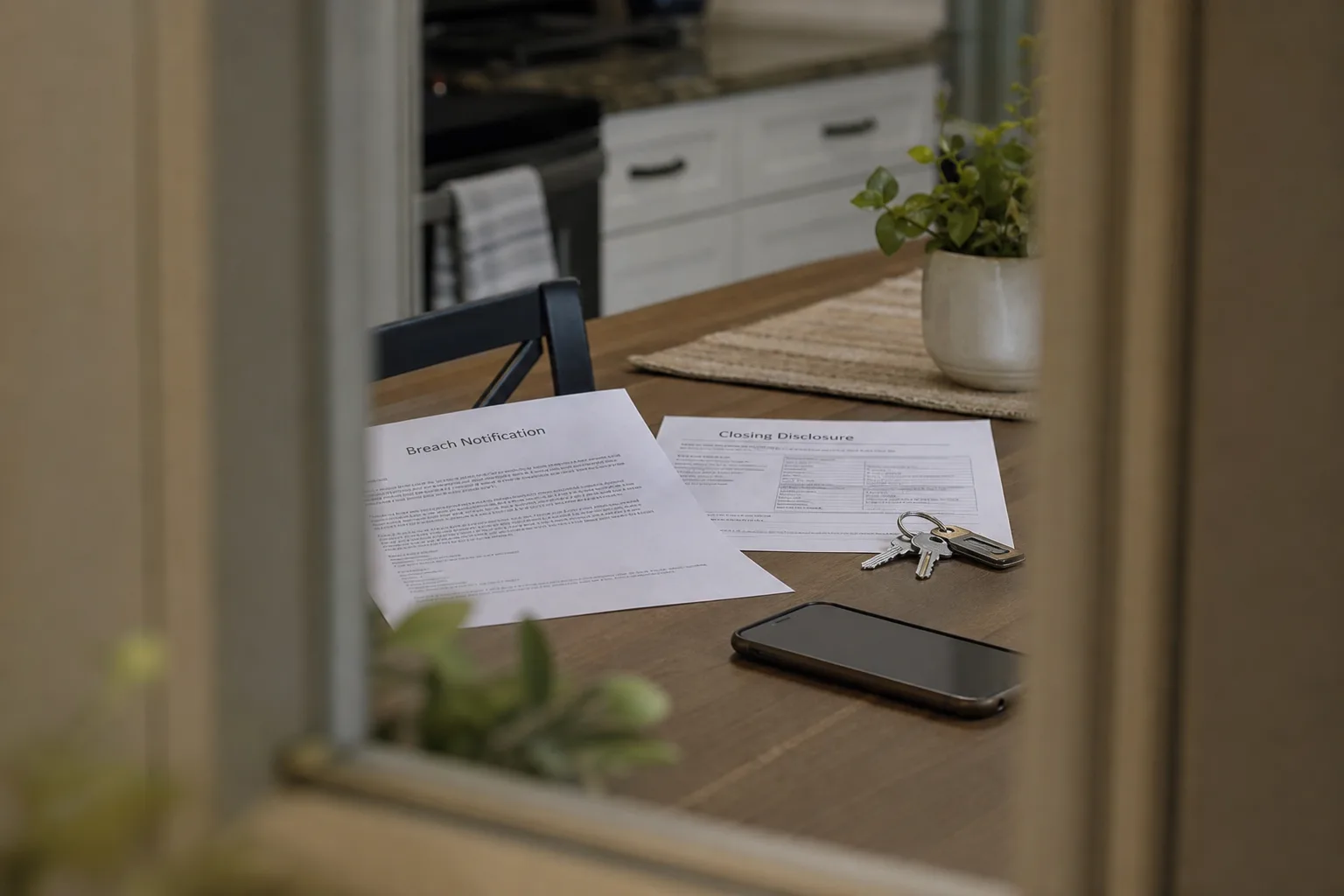
The envelope had a window and a return address she did not recognize, and it arrived on day eleven of a thirty-day escrow. The notifying company was a document imaging vendor she had never heard of, retained by the title agency handling her purchase, and the exposed file included her name, Social Security number, a scanned driver's license, and a draft wiring instruction sheet. She did exactly what the letter recommended at the top of page two. She froze her credit at all three bureaus that night. On Friday her lender tried to re-pull and could not.
The letter arrives inside a sequence that does not pause for it
A breach notice is written as though the recipient has an open calendar. Most do. A buyer under contract does not, because the loan file behind the purchase has its own clock: a rate lock with an expiration date, a final credit refresh that most lenders run within a few days of closing, and a funding deadline that the seller's own move depends on. The protective steps in the letter are all correct. What the letter cannot know is that two of them collide with a mortgage in underwriting, and that the collision is easier to prevent than to unwind.
Four people whose work was already sitting next to hers
She thought of the breach as her problem alone, which is the usual first-timer reading. It was not. The escrow officer at the title agency had a vendor relationship to account for and a duty to re-verify how funds would move. The loan officer had a credit report with a hard expiration and a lock that would cost money to extend. A fraud specialist at each bureau controlled the lift she now needed. And an identity restoration case manager, included free in the letter's enrollment offer, spent all day on exactly this problem and could tell her in four minutes which order to work it in.
The freeze, the thaw, and the day the lender pulls again
Freezing is the right instinct and it is reversible, which is what makes it safe to do quickly. The mistake is treating the freeze as a finished task rather than a switch someone will need to flip back on a specific date. She called the loan officer, asked one question, which bureau or bureaus the lender pulls from and on what day, and got a straight answer: all three, tri-merge, forty-eight hours before signing. She then scheduled a temporary lift covering that window rather than a permanent removal, and the file moved. Total delay, two business days.
The lift is where a first-timer usually loses time, because the bureaus each handle it differently and each require the PIN or account credential created at the moment of the freeze. Writing those three credentials down somewhere durable, before anything else, is the step that costs nothing and saves an afternoon. The Federal Trade Commission is the agency responsible for identity theft recovery guidance and maintains the government's reporting channel for it, and a restoration case manager will generally walk a first-time victim through that same intake rather than inventing a parallel process.
The wiring instructions are the part that cannot be taken back
Credit damage is slow and correctable. A wire is neither. Her exposed file contained a draft instruction sheet, which is precisely the document a fraudster needs to send a convincing email on closing morning, styled to match the title agency, with one digit changed in the account number. She and the escrow officer agreed on a verification rule and put it in writing: no instructions accepted by email, one phone call to a number she already had, placed by her, and a verbal read-back of the last four digits by both parties. Funds moved correctly.
That protocol is worth adopting even without a breach letter, but the letter is what made it non-negotiable, and the escrow officer did not push back for a second. People who handle closings for a living have seen the failure. Asking them to slow the wire down reads as competence, not suspicion, and it is one of the few requests in a real estate transaction that costs nobody anything.
What the file looks like a year later, and what a buyer never sees
The house closed on schedule. Her credit stayed frozen afterward, with the three PINs stored where she can reach them, and the two thaws she has needed since took under ten minutes each. None of this attaches to the property. A future buyer looking at that address will never see the vendor breach, the two-day delay, or the extra phone call before funding, because the record that survives is the deed and the payment history, both of which came out clean. The only lasting change was procedural, and she now runs it by default.
The letter she received was accurate and its advice was sound. What it could not supply was the order, and the order is what the escrow officer, the loan officer, and the restoration case manager already knew between them.